


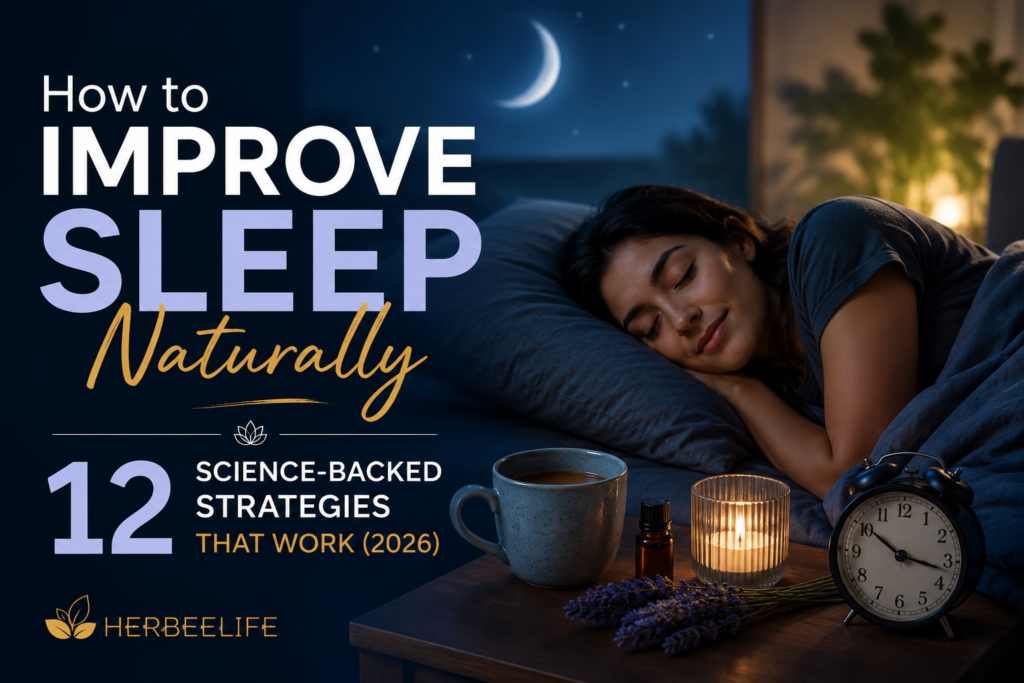
How to Improve Sleep Naturally — 12 Science-Backed Strategies That Actually Work
Can't fall asleep? Wake up exhausted? Here's the honest, science-backed guide to finally fixing your sleep — naturally, without dependency.
Quick Summary — What This Guide Covers
We cover 12 proven natural sleep strategies with the science behind each — circadian rhythm, melatonin, magnesium, ashwagandha, sleep hygiene, and more. Plus honest product recommendations for supplements, sleep masks, and calming teas that actually make a difference. No dependency. No sleeping pills. Real, lasting solutions.
Why You Can't Sleep — And Why "Just Relax" Is the Worst Advice
You're lying in bed at midnight. Your phone is face-down on the nightstand. The room is dark. You've told yourself at least four times to "just relax." And yet — nothing. Your mind is fully awake, cataloguing tomorrow's to-do list, replaying that awkward conversation from three days ago, and wondering whether you left the gas on.
Poor sleep is one of the most common health complaints in India right now — and it's getting worse. A 2023 survey by the Indian Sleep Disorders Association found that 93% of Indian adults sleep fewer hours than they need, and nearly 1 in 3 report chronic difficulty falling or staying asleep. This isn't just tiredness. Poor sleep is now directly linked to weight gain, weakened immunity, hormonal disruption, heart disease, anxiety, depression, and accelerated ageing.
But here's what most articles on sleep won't tell you: the solutions are highly individual. What works for someone else might do nothing for you — because the reason you can't sleep might be completely different from their reason. This guide is structured around that truth. We'll walk through 12 natural strategies, explain the specific mechanism behind each one, and give you a way to identify which ones are most likely to work for your particular sleep problem.
A landmark study published in Nature Reviews Neuroscience confirmed that chronic sleep deprivation (less than 7 hours for adults) elevates inflammatory markers, raises cortisol, disrupts glucose metabolism, and reduces the brain's glymphatic waste-clearance by up to 60% — increasing Alzheimer's risk over time. Sleep is not a luxury. It is maintenance.
What Actually Happens When You Sleep — The 4 Stages You Need to Know
Most people think of sleep as one long unconscious state. It's actually four distinct stages cycling every 90 minutes, and each one does something irreplaceable for your health. Understanding this changes how you approach improving sleep.
Stage 1 — Light Sleep
The transition between wakefulness and sleep. Lasts 1–7 minutes. Muscles relax, heart rate slows. Easy to wake from — this is when you "jerk" awake suddenly.
Stage 2 — True Sleep
Body temperature drops, eye movement stops, brain produces sleep spindles. You spend roughly 50% of your total sleep here. Memory consolidation begins.
Stage 3 — Deep Sleep (SWS)
The most restorative stage. Growth hormone is released, tissue repair occurs, immune cytokines are regulated. Hardest to wake from. This is where poor sleep hurts most.
Stage 4 — REM Sleep
Rapid Eye Movement sleep — where dreaming, emotional processing, and creative integration happen. Brain is almost as active as waking. Alcohol specifically suppresses this stage.
When you wake up feeling unrefreshed despite 8 hours in bed, it's almost always because your deep sleep (Stage 3) or REM sleep (Stage 4) has been disrupted — not because you didn't spend enough time in bed. The strategies below target these specific stages.
Fix Your Circadian Rhythm — The Master Clock That Controls Everything
Your circadian rhythm is a 24-hour internal clock embedded in virtually every cell of your body — governed primarily by light exposure. It controls not just when you feel sleepy, but when cortisol peaks, when digestion is most efficient, when your immune system is most active, and when your body is ready to repair itself. When this clock is misaligned — as it is for most urban Indians working late, using screens at night, and sleeping and waking at inconsistent times — every other sleep strategy becomes less effective.
The Single Most Impactful Habit: Consistent Wake Time
Research from Stanford Sleep Medicine confirms that a consistent wake time 7 days a week — yes, including weekends — is the single strongest anchor for your circadian rhythm. Not bedtime. Wake time. The reason: your cortisol awakening response (the natural morning cortisol spike that signals your brain to wake up) gets calibrated around your habitual wake time. Consistent wake time → consistent cortisol awakening response → consistent melatonin onset 14-16 hours later → easier sleep onset at night.
Choose a wake time and stick to it for 21 days — even on weekends, even if you slept badly the night before. This one habit, maintained consistently, can improve sleep quality more than any supplement. Morning sunlight exposure within 30 minutes of waking (10-15 minutes outdoors) powerfully anchors your circadian clock.
Manage Light Exposure — Blue Light Is Not the Only Problem
Everyone has heard "avoid blue light before bed." But the full picture is more nuanced and more actionable than simply putting your phone away 30 minutes before sleep.
Melatonin — the hormone that signals your body to prepare for sleep — is produced by the pineal gland in response to darkness, specifically the absence of short-wavelength blue light detected by intrinsically photosensitive retinal ganglion cells (ipRGCs) containing the photopigment melanopsin. These cells have peak sensitivity at 480nm — right in the blue light range of LED screens, fluorescent office lighting, and yes, your phone.
- 🔴Avoid overhead bright white/blue lighting after 9pm. Switch to warm amber lamps or dim lighting in the evening — this is more impactful than phone avoidance alone.
- 🔴Enable Night Mode / Warm Display on all devices after 7pm. iOS Night Shift, Android Night Light, or f.lux for laptops shift the display toward warmer (amber) wavelengths.
- ✅Get bright natural light in the morning — this is the other half of the equation most people miss. Morning light exposure suppresses melatonin (appropriate — you're awake) and sets a timer for when it will rise again that evening.
- ✅Blue light blocking glasses worn after 8pm are genuinely evidence-supported — a 2021 RCT found they improved sleep quality significantly in screen-heavy workers.
Blue Light Blocking Glasses for Evening Use
Look for glasses with amber-tinted lenses (not clear — amber blocks significantly more blue light than clear "blue light" lenses). Wear from 8pm onwards when using any screens. These are a worthwhile investment if you work on screens in the evening and struggle with sleep onset. Multiple Indian brands now offer affordable options on Amazon.
👉 Check Price on Amazon → 📢 Disclosure: This is an affiliate link. HerbeeLife earns a small commission if you purchase — at no extra cost to you. We only recommend products we genuinely believe in.
Magnesium — The Mineral Most Sleep-Deprived People Are Missing
Magnesium is involved in over 300 enzymatic reactions in the body — including several that are directly critical to sleep. It regulates GABA (gamma-aminobutyric acid) receptors — the inhibitory neurotransmitter system that "quiets" neural activity and allows sleep onset. It regulates melatonin production. And it controls the NMDA receptor system that, when overactive from magnesium deficiency, keeps the brain in a hyperaroused, alert state even when you're exhausted.
Here's why this matters for India specifically: magnesium deficiency is extremely prevalent in urban Indian populations. The shift from magnesium-rich traditional millets (bajra, ragi, jowar) to refined wheat and white rice has dramatically reduced dietary magnesium. And physical and psychological stress — both very high in modern urban Indian life — depletes magnesium through increased urinary excretion. The result is a large proportion of Indians who are both stressed and magnesium-deficient — a combination that almost guarantees poor sleep.
Not all magnesium is equal for sleep. Magnesium Glycinate is the best-studied form for sleep and anxiety — it crosses the blood-brain barrier most effectively and is the gentlest on the gut. Magnesium Oxide is cheap but poorly absorbed. Magnesium Citrate is better absorbed but has a laxative effect at higher doses. For sleep specifically — always choose Glycinate.
Magnesium Glycinate Supplement (300–400mg)
This is genuinely one of the most impactful sleep supplements available — with multiple randomised controlled trials confirming significant improvement in sleep onset, sleep duration, and sleep quality in magnesium-deficient adults. The glycinate form is the one you want — better absorbed, brain-crossing, and gentle on digestion. Take 300–400mg approximately 30–60 minutes before bed. Results are typically noticeable within 1–2 weeks of consistent use. Several good brands are available on Amazon India in this category.
👉 Check Price on Amazon → 📢 Affiliate disclosure: We earn a small commission on purchases made through this link at no cost to you.
Ashwagandha — India's Most Clinically Proven Sleep Herb
Ashwagandha (Withania somnifera) has been used in Ayurvedic medicine for over 3,000 years as a Rasayana (rejuvenative tonic) and specifically for improving sleep quality in people experiencing stress and fatigue. Modern clinical research has now confirmed multiple specific mechanisms that explain its sleep benefits.
The key compound for sleep is triethylene glycol (TEG) — found specifically in ashwagandha leaves — which has been shown in multiple studies to induce non-rapid-eye-movement (NREM) sleep through direct interaction with GABAergic pathways. The root's withanolides reduce cortisol (the stress hormone that, when elevated in the evening, prevents melatonin secretion and sleep onset) through HPA axis normalisation. A double-blind RCT published in Medicine journal found ashwagandha root extract significantly improved sleep onset, sleep quality, early morning waking, and morning alertness compared to placebo over 10 weeks.
The dose that consistently shows results in clinical trials is KSM-66 or Sensoril ashwagandha at 300–600mg daily — not the generic "ashwagandha powder" in most Indian brands which is often raw, unextracted powder with significantly lower withanolide content. Look specifically for KSM-66 standardised extract on the label.
KSM-66 Ashwagandha Extract (300–600mg)
KSM-66 is the most clinically studied ashwagandha extract in the world — with 24 clinical trials specifically supporting its efficacy. It's a full-spectrum root extract that preserves the natural ratio of bioactive compounds. For sleep, take 300mg in the morning and 300mg before bed (or 600mg before bed if you're primarily using it for sleep). Unlike sleeping pills, ashwagandha works cumulatively — most people notice meaningful sleep improvement at the 3–4 week mark, with full benefits by 8–10 weeks.
👉 Check Price on Amazon → 📢 Affiliate disclosure: Purchases through this link support HerbeeLife at no extra cost to you.
Melatonin — When to Use It and When Not To
Melatonin is probably the most misunderstood sleep supplement available. Most people take it like a sleeping pill — a large dose when they want to fall asleep. This is the wrong approach, and it's why many people find melatonin "doesn't work" for them.
Melatonin is not a sedative. It is a timing signal — it tells your brain that darkness has arrived and sleep should begin. Taking a large dose (5–10mg) does not make you sleep harder; it saturates melatonin receptors and can actually disrupt your natural melatonin production over time. The correct approach: low dose (0.5–1mg), taken 30–60 minutes before your target sleep time, used primarily for circadian rhythm adjustment (jet lag, shift work, delayed sleep phase) rather than as a nightly sleep aid.
- ✅Use melatonin for: Jet lag, shifting your sleep schedule earlier, occasional sleep onset difficulty when travelling or in a new environment.
- 🔴Don't rely on it nightly as a chronic sleep fix — address the underlying causes (light, stress, temperature, magnesium deficiency) instead.
- ✅0.5mg is usually enough — research confirms low doses are equally effective to high doses for sleep onset timing with fewer side effects.
Melatonin 0.5mg – 1mg Supplement
Look for the lowest available dose — ideally 0.5mg or 1mg sublingual (dissolves under the tongue) for fastest absorption. Many Indian brands now offer melatonin in this range. Avoid any melatonin above 3mg for regular use. This is a short-term, situational tool — not a nightly supplement. Great for jet lag after international travel, adapting to a new sleep schedule, or occasional acute insomnia.
👉 Check Price on Amazon → 📢 Affiliate disclosure: This is an affiliate link. We earn a small commission at no extra cost to you.
Chamomile Tea and L-Theanine — Calm the Anxious Mind Before Bed
For people whose sleep problem is specifically a racing, anxious mind at bedtime — thoughts that won't stop, worry about tomorrow, replaying the day — two natural compounds have the best evidence for calming this specific pattern without causing grogginess the next morning.
Chamomile Tea
Chamomile (Matricaria chamomilla) contains apigenin — a flavonoid that binds to GABA-A benzodiazepine receptors in the brain, producing mild anxiolytic (anti-anxiety) and sedative effects. It is essentially a very mild natural benzodiazepine — without the dependency or next-day impairment. A clinical trial published in Phytomedicine found chamomile extract significantly reduced generalised anxiety and improved sleep quality over 8 weeks. A cup of strong chamomile tea (steep 2 tea bags for 5 minutes in hot water) 30–45 minutes before bed is one of the simplest and most evidence-backed bedtime rituals available.
L-Theanine
L-Theanine is an amino acid found naturally in green tea that produces what researchers describe as "calm alertness" through alpha brain wave promotion — the brain state associated with relaxed wakefulness that transitions most smoothly into sleep. At doses of 100–200mg taken 30–60 minutes before bed, multiple clinical trials have confirmed significant improvement in sleep quality, reduction in sleep latency (time to fall asleep), and reduced nighttime awakenings — without morning drowsiness. It works particularly well combined with magnesium glycinate.
Organic Chamomile Tea Bags
Look for 100% pure chamomile with no added fillers. Steep 2 bags for 5 minutes in hot water. Add a small amount of raw honey if desired — honey's mild insulin response also supports tryptophan entry into the brain.
👉 Buy on Amazon 💰 Price range: ₹250–₹600L-Theanine Supplement (200mg)
The most evidence-supported dose for sleep is 200mg taken 30–60 minutes before bed. Works best for people whose sleep problem is "can't switch the mind off." Pairs beautifully with magnesium glycinate for a non-drowsy, natural calming combination.
👉 Buy on Amazon 💰 Price range: ₹600–₹1,500Temperature — The Most Overlooked Sleep Factor in India
Core body temperature must drop 1–2°C from its daytime peak to initiate and maintain deep sleep. This is not optional physiology — it is the biological trigger for deep sleep onset. The thermoregulatory system facilitates this by directing blood flow to the extremities (hands and feet), dissipating heat from the body core. This is why you feel your hands and feet warming up just before you fall asleep — your body is actively cooling its core.
In India's climate — where ambient temperatures regularly exceed 35–40°C for 6–8 months annually — this core cooling is physiologically impaired. The body cannot cool against a hot environment, and the result is: fragmented sleep, reduced deep sleep duration, frequent night-time awakening, and next-day fatigue that has nothing to do with how long you were in bed.
- ✅Keep the bedroom between 18–22°C for optimal sleep — even in summer. An AC set to 20–21°C specifically for sleeping is one of the highest-return sleep investments available.
- ✅A warm shower 1–2 hours before bed paradoxically improves sleep — by bringing blood to the skin surface for heat dissipation, it accelerates the core cooling that triggers deep sleep.
- ✅Breathable cotton or bamboo bedsheets improve temperature regulation throughout the night — synthetic materials trap heat and worsen the nocturnal temperature dysregulation.
- 🔴Avoid heavy meals within 2 hours of sleep — digestion increases core body temperature, directly competing with the cooling your body needs for deep sleep entry.
Silk or Cooling Sleep Eye Mask
A good sleep mask does two things: it blocks any residual light (even small amounts of light suppress melatonin), and a silk or cooling gel mask provides mild periorbital cooling that supports the body's natural temperature-lowering process. If you sleep in a room with any light source — street lights, LED standby lights, partner's phone — a sleep mask is one of the highest-value, lowest-cost sleep improvements available. Silk is the best material: non-irritating, temperature-regulating, and doesn't press on eyelids.
👉 Check Price on Amazon → 📢 Affiliate disclosure: Commission earned on purchases at no extra cost to you.
Lavender Essential Oil — Aromatherapy with Actual Evidence
Of all the aromatherapy approaches for sleep, lavender has the most robust clinical evidence — and a specific pharmacological mechanism that explains its effect. Linalool and linalyl acetate, the primary compounds in lavender essential oil, modulate GABA-A receptor activity (the same inhibitory neurotransmitter receptor that benzodiazepines target) when inhaled — producing measurable anxiolytic and sedative effects without systemic absorption.
A meta-analysis of 15 clinical trials published in the Journal of Alternative and Complementary Medicine found lavender aromatherapy significantly improved sleep quality, reduced anxiety scores, and increased total sleep time compared to placebo across diverse populations. A separate trial found hospital patients in ICU settings — among the most sleep-disruptive environments possible — had significantly improved sleep with lavender diffusion compared to control.
Pure Lavender Essential Oil (Therapeutic Grade)
Use 4–6 drops in a diffuser 30 minutes before and during sleep. Look for 100% pure lavender oil with no synthetic additives — the therapeutic effect comes from linalool content, which synthetics don't replicate.
👉 Buy on Amazon 💰 Price range: ₹400–₹1,200Ultrasonic Aroma Diffuser (Bedroom Size)
A USB-powered ultrasonic diffuser for the bedroom is a one-time purchase that works for every aromatherapy oil. Look for one with a timer function (2-hour auto-shutoff is ideal for sleep use) and no bright LED indicator lights.
👉 Buy on Amazon 💰 Price range: ₹600–₹2,000Exercise Timing — One of the Most Powerful (and Most Misused) Sleep Tools
Regular aerobic exercise is one of the most evidence-backed natural sleep interventions available — a meta-analysis of 66 studies found exercise significantly improved sleep quality, total sleep time, and sleep efficiency while reducing insomnia symptoms, with effect sizes comparable to sleep medication. The mechanism: exercise increases adenosine (the sleep pressure molecule that builds through the day and drives sleep onset), reduces cortisol baseline, raises body temperature (which then drops post-exercise — the same cooling that triggers sleep onset), and improves the regulation of circadian rhythm through BDNF and PGC-1α pathways.
The Timing Question
This is where most people get confused. Morning and afternoon exercise consistently improves sleep quality. Evening exercise (within 2–3 hours of bedtime) has mixed evidence — vigorous exercise too close to sleep can delay sleep onset in some people by elevating core temperature and adrenaline. However, gentle evening exercise (yoga, walking, light stretching) does not have this effect and may actually improve sleep by reducing cortisol.
Vigorous exercise (running, HIIT, gym) before 6pm when possible. Gentle movement (yoga, walking, stretching) is fine any time including the evening. If morning is your only available time — that's fine too. The sleep benefit of any regular exercise outweighs timing concerns.
The Bedtime Routine — Your Brain Needs a Signal That Sleep Is Coming
Your brain learns through pattern association. If you scroll Instagram, respond to work messages, and watch intense content right up until you close your eyes — your brain has learned that bedtime is a high-stimulation, high-alertness environment, and it prepares accordingly. The solution is not willpower — it's replacing the pattern with one that signals the opposite.
A consistent 30–60 minute wind-down routine performed at the same time each night becomes a Pavlovian cue for sleep — your nervous system begins shifting toward parasympathetic (rest-and-digest) dominance as soon as the routine begins, before you've even attempted to sleep.
Dim all lights. Switch devices to night mode.
This begins the melatonin rise that will peak at sleep onset. Overhead bright lights off — use a bedside lamp with warm-toned bulb if you need light for reading.
Warm shower or bath. Chamomile tea.
The shower accelerates core body cooling (as above). The chamomile provides apigenin's mild anxiolytic effect as it absorbs over the next 30 minutes.
Journaling, reading (physical book), or gentle stretching.
Write down tomorrow's to-do list (offloading it from working memory reduces nighttime rumination). Read physical books — not e-readers. Light stretching activates the parasympathetic system.
Phone completely outside the bedroom. 4-7-8 breathing.
Inhale for 4 counts, hold for 7, exhale for 8. Repeat 4 times. This breathing pattern activates the vagal brake — measurably reducing heart rate and cortisol within minutes.
Nutrition for Sleep — The Foods That Help and the Ones That Steal Your Rest
What you eat — and when you eat it — directly affects your sleep architecture. The gut produces 95% of the body's serotonin, which is the direct precursor to melatonin. The gut microbiome affects GABA production. Blood sugar instability produces cortisol spikes at 2–4am that wake you. Getting sleep nutrition right addresses multiple mechanisms simultaneously.
Foods That Support Sleep
- ✅Warm milk with a pinch of nutmeg — tryptophan (the melatonin precursor amino acid) + the mildly soporific myristicin in nutmeg. The most classically Indian sleep remedy with genuine pharmacological basis.
- ✅Tart cherries / cherry juice — one of the few foods with naturally high melatonin content. Multiple trials confirm tart cherry consumption increases sleep time and quality.
- ✅Bananas — magnesium + tryptophan + potassium. A banana before bed is genuinely sleep-supportive, not just a folk remedy.
- ✅Almonds — magnesium-rich. A small handful in the evening provides a meaningful magnesium contribution alongside healthy fats that stabilise blood sugar overnight.
- 🔴Avoid caffeine after 2pm — caffeine's half-life is 5–7 hours. A 4pm coffee still has 50% of its caffeine in your system at 10pm, actively blocking adenosine receptors.
- 🔴Avoid alcohol — alcohol sedates initially but fragments sleep in the second half of the night by suppressing REM sleep and causing acetaldehyde-driven awakenings at 2–4am.
- 🔴Avoid large meals within 2 hours of sleep — digestive thermogenesis raises core body temperature, competing with the cooling needed for deep sleep entry.
Stress Management — Because Cortisol Is the Arch-Enemy of Sleep
Cortisol and melatonin have an inverse relationship — when one is high, the other is low. Cortisol is your alerting hormone; melatonin is your sleep signal. In the normal circadian pattern, cortisol peaks at 7–9am and falls through the day to its lowest around midnight. Chronic stress disrupts this pattern — keeping cortisol elevated in the evening, directly suppressing melatonin secretion and preventing the brain from shifting into sleep-prep mode.
This is why people under chronic stress have the "tired but wired" pattern — simultaneously exhausted from the day and unable to fall asleep when they finally lie down. Their cortisol is too high for melatonin to rise. No supplement and no technique will fully overcome chronically elevated evening cortisol — addressing the underlying stress load is essential.
The Most Evidence-Backed Stress-Reduction Techniques for Sleep
- ✅Meditation — even 10 minutes daily has documented cortisol-reducing effects within 2–4 weeks of consistent practice. Apps like Headspace, Calm, or free YouTube guided meditations work. The mechanism: prefrontal cortex activation reduces amygdala reactivity — the brain literally becomes less stress-responsive.
- ✅Journaling at bedtime — specifically writing a "worry dump" (all current concerns on paper) and a "grateful moments" list has been shown in clinical trials to reduce pre-sleep cognitive arousal and improve sleep onset.
- ✅Yoga Nidra — the most powerful Indian sleep-induction practice, producing the EEG brain wave pattern of the sleep-wake threshold while remaining conscious. Multiple clinical trials confirm it reduces insomnia and lowers cortisol.
Guided Sleep & Gratitude Journal
A structured bedtime journal that guides you through a nightly worry offload, gratitude reflection, and next-day intention — replacing the phone-scrolling habit with a proven cognitive offloading practice that reduces pre-sleep rumination. Numerous studies confirm journaling before bed improves sleep quality and reduces time to fall asleep. Multiple options available on Amazon India, from simple ruled notebooks to structured guided journals with sleep prompts.
👉 Check Price on Amazon → 📢 Affiliate disclosure: Commission earned on purchases at no extra cost to you.
All Recommended Sleep Products — Quick Reference
Here's a quick summary of every product recommended in this guide, what it's best for, and where to find it:
| Product | Best For | Price Range | Link |
|---|---|---|---|
| Magnesium Glycinate | Racing mind, difficulty falling asleep, restless legs | ₹700–₹1,800 | Amazon → |
| KSM-66 Ashwagandha | Stress-related insomnia, 3am waking, fatigue + poor sleep | ₹600–₹2,000 | Amazon → |
| Melatonin 0.5–1mg | Jet lag, shifting sleep schedule, occasional insomnia | ₹300–₹800 | Amazon → |
| L-Theanine 200mg | Anxious, overthinking mind at bedtime | ₹600–₹1,500 | Amazon → |
| Chamomile Tea | Mild anxiety, gentle sleep onset support, bedtime ritual | ₹250–₹600 | Amazon → |
| Lavender Essential Oil | General sleep quality improvement, aromatherapy | ₹400–₹1,200 | Amazon → |
| Ultrasonic Diffuser | Essential oil diffusion for sleep environment | ₹600–₹2,000 | Amazon → |
| Silk Sleep Mask | Light-sensitive sleepers, travellers, shift workers | ₹300–₹1,200 | Amazon → |
| Blue Light Glasses | Evening screen users, IT professionals, students | ₹400–₹1,500 | Amazon → |
| Sleep Journal | Bedtime overthinking, anxiety-related insomnia | ₹200–₹800 | Amazon → |
5 Sleep Myths That Are Making Your Insomnia Worse
"You can catch up on lost sleep over the weekend." Two nights of extra sleep do not restore the cognitive impairment, metabolic disruption, or immune compromise of a week of poor sleep. And the weekend lie-in shifts your circadian rhythm, making Monday morning worse.
Sleep debt is partially repayable — but only through consistent improvement in nightly sleep, not through occasional long weekend sleeps that disrupt your circadian rhythm further. Consistency is more restorative than occasional catch-up.
"Alcohol helps you sleep." Alcohol makes you fall asleep faster (sedation) but fragments sleep in the second half of the night — suppressing REM sleep, causing early awakening, and reducing total sleep quality. The sleep it produces is not restorative sleep.
Even one drink reduces REM sleep by up to 24% in the second half of the night. Two drinks eliminates meaningful REM in many people. Alcohol is among the most damaging common sleep disruptors — not a sleep aid.
"If you can't sleep, stay in bed and try harder." Lying awake in bed for long periods trains your brain to associate the bed with wakefulness and anxiety — worsening insomnia over time through conditioned arousal.
If you haven't fallen asleep within 20 minutes, leave the bed. Go to another room, do something quiet in dim light (reading, gentle stretching), and return only when sleepy. This is the core principle of sleep restriction therapy — the most effective CBT-I technique.
"8 hours is the magic number for everyone." Sleep need is individual and largely genetic — the true range for adults is 7–9 hours, with some people genuinely thriving on 6.5 hours and others needing 9.5 hours.
The right amount of sleep for you is what allows you to wake without an alarm feeling refreshed, maintain energy through the day without caffeine, and not feel sleepy in the early afternoon. Tune to your body, not a number.
Your Most Common Sleep Questions — Answered Honestly
Q: I've tried everything and still can't sleep. What should I do?
If you have consistently poor sleep for more than 3 months despite implementing sleep hygiene, managing stress, avoiding caffeine and alcohol, and trying the natural supplements above — you likely have clinical insomnia disorder and would benefit significantly from Cognitive Behavioural Therapy for Insomnia (CBT-I). CBT-I has a 70–80% success rate in clinical trials, outperforms sleeping medication at 12 months, and produces lasting improvement without dependency. Ask your GP for a referral or access an online CBT-I programme.
Q: Can I take magnesium and ashwagandha together?
Yes — these two supplements have complementary mechanisms and are frequently taken together. Magnesium glycinate addresses the GABAergic and neurological component (racing mind, difficulty falling asleep), while ashwagandha addresses the HPA axis and cortisol component (stress-driven sleep disruption, early morning waking). They work on different pathways and are safe to take together at the recommended doses.
Q: How long does it take for natural sleep remedies to work?
Chamomile tea and L-theanine can improve sleep onset the same night. Magnesium glycinate typically shows meaningful effect within 1–2 weeks. Ashwagandha produces progressive improvement over 4–10 weeks. Circadian rhythm correction from consistent wake time typically shows improvement within 2–3 weeks. Addressing all factors simultaneously produces the fastest results — but expect a 2–4 week period before the full benefit is apparent.
Q: Is it bad to take melatonin every night?
Short-term use (up to 13 weeks at low doses) appears safe based on current evidence. Long-term nightly use at doses above 1mg may potentially reduce your body's natural melatonin production through receptor downregulation — the evidence is still emerging. The position of most sleep medicine specialists: use melatonin situationally (jet lag, schedule adjustment, occasional insomnia) rather than as a nightly dependency. For chronic insomnia, magnesium glycinate and ashwagandha are safer long-term options.
Q: Does warm milk actually help sleep?
Yes — with caveats. Milk contains tryptophan (the serotonin/melatonin precursor), calcium (which helps the brain use tryptophan), and magnesium. The warm temperature additionally has mild soporific effects through parasympathetic activation. However, the tryptophan content of a glass of milk is relatively modest compared to the doses studied in clinical trials. Its sleep benefit is real but mild — a useful part of a bedtime routine, not a standalone insomnia treatment. A pinch of nutmeg in warm milk adds myristicin, which enhances the mild sedative effect.
Q: Should I track my sleep with a smartwatch?
Tracking can be useful for identifying patterns — but use it strategically, not obsessively. Some people develop "orthosomnia" (anxiety about their sleep data) which paradoxically worsens insomnia. Use sleep tracking for 2–4 weeks to identify patterns (what time you're actually falling asleep, how fragmented your sleep is, correlation with alcohol or exercise) — then use that data to adjust your approach, not to stress about your daily sleep score.
You Might Also Find These Helpful
Natural Remedies for Anxiety and Stress
12 science-backed strategies to calm your nervous system — and why stress management is the most overlooked sleep fix.
😴Why You're Always Tired Even After Sleeping
12 real medical causes of fatigue despite adequate sleep — from iron deficiency to thyroid to sleep apnoea.
🌿Ashwagandha: Complete Benefits Guide
The full science on KSM-66, who should take it, who should avoid it, and the right dosage for sleep and stress.
🔥10 Signs Your Body Has Too Much Inflammation
Chronic inflammation disrupts sleep — and poor sleep worsens inflammation. Break the cycle here.
Get Daily Wellness Tips
We share daily evidence-based natural health and wellness content across all platforms. Join the HerbeeLife community — it's free, genuinely useful, and actually enjoyable.
Research & Clinical Evidence
- 📖 Walker M — Why We Sleep: Sleep deprivation and metabolic, cognitive and immune consequences (NIH/Nature)
- 📖 Chandrasekhar K et al — Ashwagandha (KSM-66) and sleep quality: double-blind RCT (Medicine Journal, 2019)
- 📖 Abbasi B et al — Effect of magnesium supplementation on insomnia in elderly: double-blind RCT (Journal of Research in Medical Sciences)
- 📖 Hieu TH et al — Lavender aromatherapy and sleep — systematic review (Journal of Alternative and Complementary Medicine)
- 📖 Amsterdam JD et al — Chamomile (Matricaria recutita) and generalised anxiety — RCT (Phytomedicine)
- 📖 Czeisler CA — Melatonin and circadian rhythm — Harvard Medical School review (Sleep Medicine Clinics)
- 📖 Kline CE — The bidirectional relationship between exercise and sleep — systematic review (American Journal of Lifestyle Medicine)
Which Sleep Strategy Are You Going to Try First? 🌙
Whether it's the consistent wake time, the magnesium glycinate, the chamomile tea before bed, or finally moving your phone out of the bedroom — the most important thing is picking one strategy and starting tonight. Not next week. Tonight. Sleep debt accumulates daily, and so does sleep improvement when you consistently give your body what it needs. Drop a comment below — tell us your biggest sleep struggle and which strategy from this guide you're trying first. We read every comment, and your question might inspire our next deep-dive article. 💬
Want More Evidence-Based Wellness Guides Like This?
HerbeeLife publishes honest, research-backed natural health content every week — no fluff, no fear-mongering, no quick-fix promises. Just genuinely useful guidance for living well naturally.
🌿 Explore HerbeeLife → 📸 Follow on Instagram