


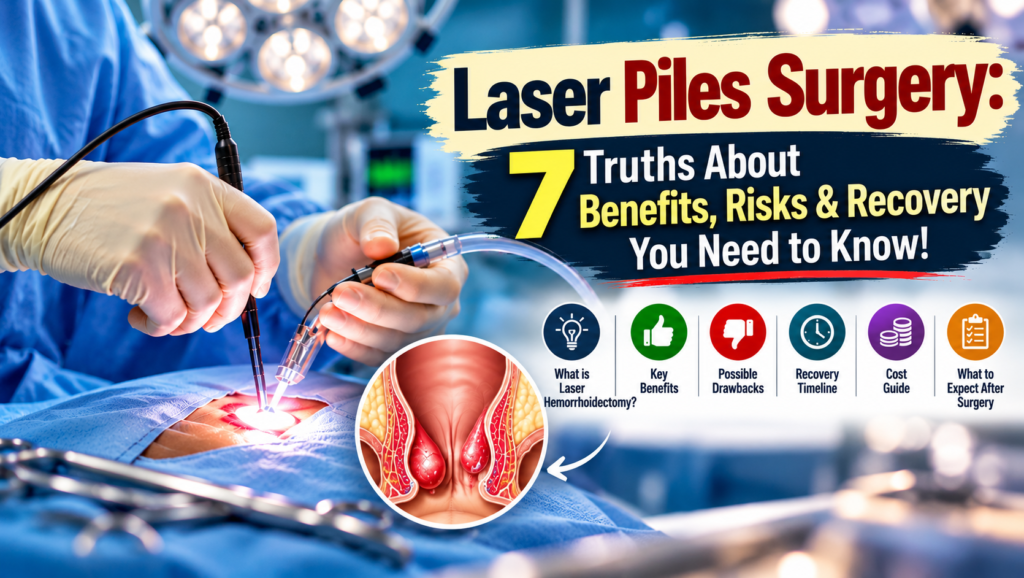
"Laser piles surgery" is advertised everywhere. The truth sits somewhere between miracle and gimmick.
If you have piles, you have probably seen the promises: no cuts, no pain, back at work tomorrow, never comes back. Some of that is real, and some of it is marketing. This guide explains what laser treatment for hemorrhoids actually does, which patients it suits, how it compares with other options, what recovery looks like and what to ask your surgeon. We also cover the home care and Ayurvedic home remedies that help before and after any procedure.
Updated for 2026 | 13 min read | Honest pros, cons and questions to ask
First, what are piles? Understanding the four grades
Hemorrhoids are soft, blood-rich cushions inside the anal canal that everyone has. They become "piles" when they swell and cause symptoms such as bright red bleeding after a motion, itching, a lump, mucus or discomfort. Internal piles are inside and usually painless. External piles sit under the skin around the anus and can become suddenly painful if a clot forms.
Doctors grade internal piles from 1 to 4, and the grade often decides which treatment makes sense.
Bleeds, stays inside
Painless bleeding, no lump coming out. Usually managed with fibre, fluids and habits.
Slips out, goes back
Comes out when you strain and returns on its own.
Needs pushing back
Comes out and has to be pushed back in with a finger.
Stays out
Permanently outside and cannot be pushed back. Often needs surgery.
Straining is the common thread. If constipation is behind your piles, fixing that is the single most useful step, and our guide to natural remedies for constipation shows how.
Treatment ladder: what usually comes first
Most piles do not need an operation. Doctors usually work up the ladder, and many people never reach the top.
| Step | What it involves | Typically used for |
|---|---|---|
| 1. Habits and fibre | 25 to 30 g fibre a day, plenty of fluid, no straining, no long sitting on the toilet, warm sitz baths | All grades, and always alongside other treatments |
| 2. Medicines | Short courses of creams or suppositories, stool softeners, and sometimes flavonoid tablets on a doctor's advice | Symptom relief in flare-ups |
| 3. Office procedures | Rubber band ligation, sclerotherapy, infrared coagulation | Mainly grades 1 to 3 |
| 4. Minimally invasive surgery | Doppler-guided artery ligation, laser hemorrhoidoplasty, stapled hemorrhoidopexy | Selected grade 2 to 3 piles |
| 5. Conventional hemorrhoidectomy | Surgical removal of the piles | Large grade 3 to 4, mixed internal and external piles, failed treatments |
"Laser piles surgery" means two different things
This is the single most useful thing to understand before you pay for anything. Clinics often use the same name for two different procedures.
Laser hemorrhoidoplasty (LHP)
- A thin laser fibre is placed inside the pile tissue and delivers energy that shrinks it from within.
- The pile is not removed, so wounds are tiny.
- Usually less pain and faster return to routine than conventional surgery.
- Best for selected grade 2 to 3 internal piles.
Laser hemorrhoidectomy (excision)
- Laser is used instead of a scalpel or cautery to cut away the pile.
- The operation is the same as conventional hemorrhoidectomy, only the tool differs.
- Results and pain after surgery may be similar to the conventional operation.
- Can treat larger or grade 3 to 4 piles and skin tags.
When someone says "laser piles surgery", ask which of the two they mean, and why it fits your grade. A good surgeon will explain this without defensiveness.
How laser hemorrhoidoplasty works, step by step
Examination to confirm grade and rule out other causes of bleeding.
Local with sedation, spinal or general, as a day-care procedure.
A tiny laser fibre is inserted into each pile, guided from outside.
Short bursts shrink the tissue and reduce its blood supply.
Most patients go home the same day with instructions.
Over the following weeks the treated tissue shrinks and scars down, which reduces bleeding and swelling. If you also have large skin tags, a fissure or a fistula, those usually need separate treatment. Our guide to laser surgery for anal fissures and fistulas explains those procedures.
Is laser right for you?
| Your situation | Laser hemorrhoidoplasty | Comment |
|---|---|---|
| Grade 1 bleeding piles | Rarely needed | Fibre, habits and simple treatments usually work. |
| Grade 2 piles, not improving | Often a good option | Banding is the main alternative. |
| Grade 3 piles | Possible, chosen carefully | Higher chance of recurrence than excision in some studies. |
| Grade 4 or large prolapse | Usually not enough | Conventional surgery tends to be more reliable. |
| Painful clotted external pile | Not the treatment | Early clot excision or conservative care is used. |
| Large skin tags | Needs added step | Skin tags have to be trimmed separately. |
| Fissure or fistula as well | Plan together | Your surgeon should treat all problems in a coordinated way. |
| Blood thinners, bowel disease, pregnancy | Specialist decision | Often deferred or treated conservatively first. |
An honest scorecard of the main options
General patterns from studies. Individual results depend heavily on the surgeon and the patient.
| Option | Pain afterwards | Recovery | Chance piles return | Best for |
|---|---|---|---|---|
| Rubber band ligation | Mild to moderate | Very quick | Moderate | Grades 1 to 3, first choice for many |
| Laser hemorrhoidoplasty | Usually low | Quick | Moderate; higher than excision in advanced grades | Selected grade 2 to 3 |
| Doppler-guided ligation | Low | Quick | Moderate | Grade 2 to 3 with some prolapse |
| Stapled hemorrhoidopexy | Lower than excision | Quick | Higher prolapse recurrence; rare serious complications | Circular prolapse, in selected patients |
| Conventional hemorrhoidectomy | Highest | Longest (a few weeks) | Lowest | Advanced, mixed or recurrent piles |
In plain terms: laser can mean a gentler recovery, but for bigger piles you may trade comfort now for a higher chance of repeat treatment later. A fair surgeon will tell you which side of that trade-off applies to you. Claims such as "100 percent cure" or "never comes back" are not supported by evidence.
The art has three factors: the disease, the patient and the physician. As to disease, make a habit of two things: to help, or at least to do no harm.
Hippocrates, ancient Greek physician, Epidemics, Book I (standard English translation)Recovery: what the first 14 days usually look like
This is a general guide for hemorrhoidoplasty. Excisional surgery recovers more slowly. Follow your own surgeon's instructions.
Back home
Most go home the same day. Mild burning or fullness is common. Take medicines exactly as prescribed.
Settling in
Light spotting or discharge is normal. Warm sitz baths after each motion, soft stools, short walks.
Back to routine
Many return to desk work. Avoid heavy lifting, long bike or bumpy rides and straining.
Healing on
Symptoms ease as tissue shrinks. Keep fibre and fluids up, and attend your follow-up visit.
- Bleeding that soaks pads or does not slow down, or passing large clots.
- Severe or worsening pain, fever, chills, or foul-smelling discharge.
- Difficulty passing urine, which can happen after anal procedures.
- No bowel movement for several days despite stool softeners.
Home care and Ayurvedic support: before and after any procedure
These steps help relieve symptoms and lower the chance that piles come back. They are not a replacement for treatment of large or bleeding piles.
Keep stools soft
- Aim for 25 to 30 g fibre a day: oats, dalia, vegetables, fruit, lentils.
- Two to three litres of fluid daily, unless your doctor limits it.
- Psyllium husk with a full glass of water, started slowly.
- Prunes, kiwi and soaked raisins are well-known gentle helpers.
Warm sitz baths
- 10 to 15 minutes in comfortably warm water, two to three times a day and after motions.
- Pat dry gently, do not rub.
- Traditionally, triphala or panchavalkala decoction is added. Patch test first.
Toilet habits
- Go when you feel the urge. Do not hold on.
- No phone, and no more than five minutes.
- Use a footstool so knees sit above hips.
- Wash with water or use alcohol-free wipes instead of rough paper.
Everyday habits
- Walk daily, and avoid sitting for hours without breaks.
- Maintain a healthy weight. See our plan for losing belly fat naturally at home.
- Add oats and legumes, also helpful for the heart. See natural ways to lower cholesterol.
- Extra fibre can cause gas at first, so read foods that reduce bloating.
What about Ayurvedic treatments for piles?
In Ayurveda, piles are called arsha. Besides diet and herbs such as triphala, haritaki and abhayarishta, Ayurvedic proctology offers procedures like kshar karma (application of a medicated alkaline paste) and ligation under a trained specialist. Evidence is more limited than for banding or surgery, and results depend heavily on the practitioner. If you choose this route, pick a qualified Shalya Tantra specialist, and avoid unlabelled herbal powders. Some "piles medicines" sold online or in clinics have been found to contain hidden steroids.
Anxiety about surgery is natural, and calm breathing helps. See our guide to natural remedies for anxiety and stress.
Nine questions to ask your surgeon
Write these down and take them to your appointment. A good surgeon will welcome them.
- What grade are my piles, and are there other problems such as a fissure, skin tags or a fistula?
- Do I need any tests first, such as a colonoscopy, given my age and symptoms?
- Why laser rather than banding or conventional surgery, for my case?
- Is this laser hemorrhoidoplasty (shrinking) or laser excision (cutting)?
- In your own practice, how often do piles come back, and what happens then?
- What are the risks, including bleeding, urine problems and effects on bowel control?
- What type of anaesthesia will I have, and how long before I can go home and return to work?
- What is the total cost, what does it include, and what will my insurance cover?
- What follow-up do I need, and what should I do if something goes wrong?
On insurance in India: many health policies treat piles as a "specified illness" with an initial waiting period (often one to two years), and the extra cost of laser consumables may or may not be covered. Ask your insurer for pre-authorisation in writing before the procedure. A second opinion before surgery is reasonable.
Red flags and scams to avoid
Be careful if you hear:
- "100 percent cure", "never comes back" or "no pain at all".
- "Laser will fix everything" with no examination or grading.
- Pressure to decide on the spot, or fear tactics such as "this will turn into cancer".
- No clear information about the surgeon's qualifications or the device used.
- Herbal or "Ayurvedic" capsules and ointments without a proper ingredient list or licence.
- A bill that lumps everything together with no breakdown.
Look for a qualified surgeon (such as MS or MCh with experience in anorectal or colorectal surgery, or a qualified Shalya Tantra specialist for Ayurvedic procedures), a transparent estimate and a willingness to explain alternatives.
Comfort and care helpers
None of these treats piles or replaces a doctor, but each can make daily life easier. Pick only what suits you.
Himalaya Pilex Tablets
A well-known herbal formulation used for symptom relief in piles. Check the label and ask your doctor, especially if you are pregnant or take other medicines. It does not replace evaluation of bleeding.
Kottakkal Arya Vaidya Sala Abhayarishtam
A classical Ayurvedic fermented preparation traditionally used for piles and constipation. It contains naturally generated alcohol and is best taken on a vaidya's advice.
Orthopaedic memory foam seat cushion with tailbone cut-out
Takes pressure off the anal area during desk work and car rides, especially in the first weeks after a procedure. Choose a firm, breathable foam in a size that fits your chair.
Tynor Hot and Cold Gel Pack
A reusable pack for soothing swelling (cold, wrapped in cloth) or comfort (warm). Never place ice or a hot pack directly on skin, and use it for short periods only.
Alcohol-free, fragrance-free flushable wipes for sensitive skin
A gentle alternative to dry toilet paper when the area is sore. Check that they are labelled alcohol-free and fragrance-free, and avoid ones with menthol.
The bottom line
Laser can be a good tool for the right piles, and its gentler recovery is real. But it is one option among several, not a universal cure, and the best choice depends on your grade, your health and your surgeon's experience. Start with the basics, get a proper diagnosis, ask the nine questions above and be wary of anyone who promises certainty. For more gentle, practical guidance, explore our full collection of Ayurvedic home remedies.
Stay connected with Herbeelife
Follow us for practical, honest health guidance and Ayurvedic tips. Save this guide and share it with someone who is quietly struggling.
Save on Pinterest Follow on Instagram Join on FacebookFrequently asked questions
Is laser hemorrhoidectomy the best treatment for piles?
Not for everyone. Laser hemorrhoidoplasty is a good option for selected grade 2 to 3 internal piles, with usually less pain and a quicker recovery. For large or grade 4 piles, conventional surgery is often more reliable. The best treatment depends on your grade, health and your surgeon's experience.
Is laser piles surgery painless?
You are anaesthetised during the procedure, so you will not feel it. Afterwards, discomfort is usually milder than after conventional surgery, but some burning, fullness and spotting are normal. "Completely painless" is an exaggeration.
Can piles come back after laser treatment?
Yes. Recurrence can happen, particularly with advanced grades or if constipation and straining continue. Good fibre and fluid habits lower the risk. Ask your surgeon about their own recurrence experience.
How long is recovery after laser hemorrhoidoplasty?
Most people go home the same day and many return to desk work within a few days to a week, though the tissue continues to heal for several weeks. Excisional surgery usually takes longer. Follow your own surgeon's guidance.
Who should not have laser piles surgery?
It is usually not the right choice for grade 4 piles, large prolapse, painful clotted external piles, or when bleeding has not been properly investigated. Pregnancy, blood thinners, inflammatory bowel disease, and other anal conditions need a specialist decision.
Is laser piles surgery covered by insurance in India?
Often, piles surgery is covered as a day-care procedure, but many policies have an initial waiting period for piles and may not cover the extra cost of laser consumables. Ask your insurer for pre-authorisation in writing before the procedure.
Can piles be cured at home without surgery?
Mild piles often improve with fibre, fluids, sitz baths and healthy toilet habits. Larger or persistent piles may need procedures. See a doctor if bleeding is frequent, if a lump stays out, or if symptoms do not improve within a couple of weeks.
Disclaimer: This article is for general information and is not medical advice, diagnosis or treatment. It does not promote any hospital, doctor or device. Rectal bleeding and anal symptoms should be evaluated by a qualified doctor. If you are pregnant, breastfeeding, taking medicines or have a medical condition, please speak to your doctor before using any herbal product. Results vary from person to person. Affiliate disclosure: Some links in this article are affiliate links. If you buy through them, Herbeelife may earn a small commission at no extra cost to you. As an Amazon Associate, we earn from qualifying purchases.