


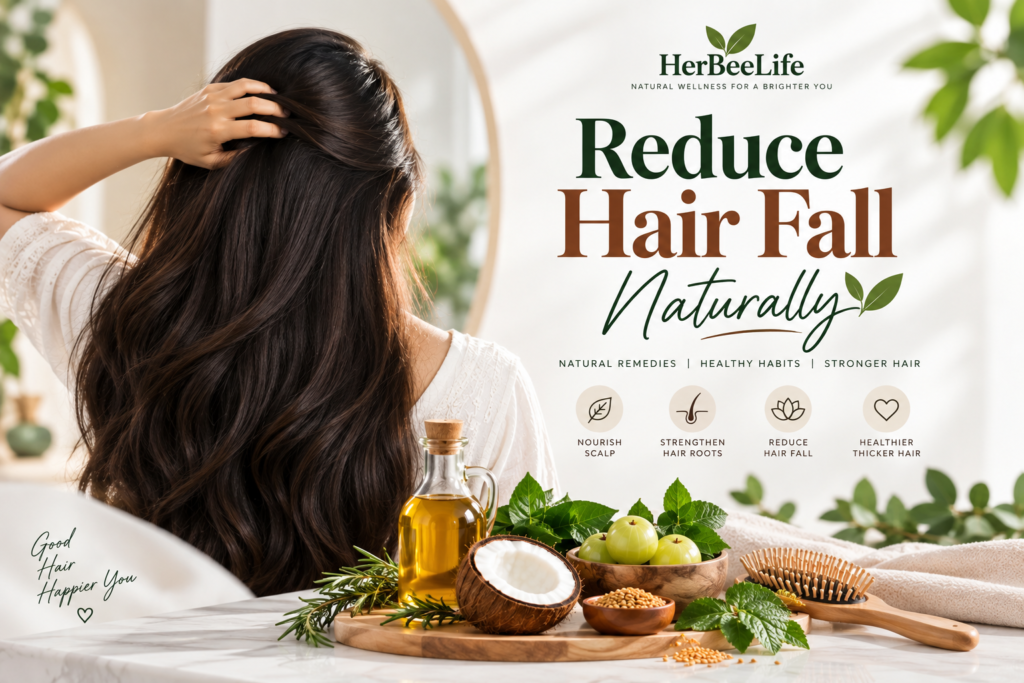
The honest truth about "natural" hair fall solutions: most of them work — just not overnight, and rarely alone. This guide organizes the ingredients actually worth trying, the daily habits that quietly undo your efforts, and a realistic 30-day plan built around Ayurvedic home remedies that have stood the test of time — not just this week's trend.
Food functions either as medicine or as a slow-working toxin, depending on what's chosen — a principle that applies to hair and skin every bit as much as to the rest of the body.
— Dr. Andrew Weil, Integrative Medicine PioneerIf you've searched "reduce hair fall naturally" more than once this year, you already know the internet isn't short on advice — it's short on advice that actually holds up. Coconut oil, amla, and onion juice keep showing up for a reason: there's real chemistry behind them. The difference between people who see results and people who don't usually isn't the remedy — it's whether they stuck with it long enough and paired it with habits that support the strand instead of working against it.
Kitchen Ingredients That Genuinely Help
These aren't exotic imports — most are sitting in your kitchen right now. Here's what each one actually does, and how to use it without wasting half the jar.
Coconut Oil
Its unique fatty-acid structure lets it penetrate the hair shaft rather than just coat it, reducing protein loss from daily wear. Warm slightly, massage in before bed, rinse in the morning.
Soulflower Cold-Pressed Virgin Coconut Oil →Amla (Indian Gooseberry)
One of the richest natural sources of vitamin C, amla supports collagen synthesis in the follicle and is traditionally credited with slowing premature greying.
Indus Valley Amla & Bhringraj Hair Oil →Egg
A near-complete protein source; a mask of whisked egg and a few drops of oil temporarily fills gaps in damaged cuticle, leaving hair visibly smoother post-rinse.
Onion Juice
High in sulfur, which plays a role in collagen production and is believed to support circulation at the follicle when massaged in consistently.
Ginger
Contains gingerol, a compound with anti-inflammatory properties that may help calm an irritated, flaky scalp — a common but overlooked contributor to shedding.
Fenugreek (Methi)
Soaked seeds release a mucilage rich in proteins and nicotinic acid, traditionally ground into a scalp mask to reduce breakage and add shine.
Trichup Methi Hair Fall Control Oil →Jojoba Oil
Structurally closest to the scalp's own sebum, so it absorbs without residue and works well for balancing oily, hair-fall-prone scalps.
Just Jaivik Organic Jojoba Oil →Green Tea
Rich in catechins, a class of antioxidants shown to support follicle health; cooled tea makes a simple final rinse, or a daily cup supports it from within.
Vahdam Teas Emerald Green Tea →These ingredients pair especially well with herbs already covered on the blog — see how curry leaves and Manjistha extend this same natural toolkit, and if shedding is your main concern right now, our deeper dive into home remedies for hair fall is worth reading alongside this one.
The Habits That Quietly Undo Your Efforts
You can be diligent with every mask on this page and still see little change if these habits stay unaddressed.
Keep Doing
- Sleeping 7–8 hours consistently
- Eating protein at every meal, not just dinner
- Detangling gently with a wide-tooth comb
- Rinsing with cool, not hot, water
- Trimming every 8–10 weeks
Quietly Sabotaging You
- Tight ponytails and buns worn daily
- Daily heat styling without protection
- Sulfate-heavy shampoo used every single day
- Skipping meals or crash dieting
- Ignoring ongoing stress or poor sleep
A gentle detangling tool matters more than people expect — rough combing on wet hair is one of the most common, most avoidable causes of breakage.
The Better Home Bamboo Wide-Tooth Detangling Comb is a simple, eco-friendly swap that reduces pulling on wet strands without adding another step to your routine.
A Realistic 30-Day Natural Reset
Results compound. Here's a structure that's demanding enough to matter, but not so demanding you'll quit by week two.
Week 1 — Build the Base
Start twice-weekly oiling (coconut or amla), swap to a sulfate-free shampoo, and add one protein-rich food to breakfast daily.
Week 2 — Add Circulation
Introduce a five-minute daily scalp massage and begin a cool-water final rinse after every wash.
Week 3 — Layer in Actives
Add a weekly fenugreek or onion-juice mask, and start a daily cup of green tea in place of a second coffee.
Week 4 — Lock in the Routine
Review what's working, drop what isn't, and commit to the two or three habits that fit your life long-term — this is the step most people skip, and it's the one that actually matters.
What a Hair-Supportive Plate Looks Like
Ingredients matter more than supplements when your baseline diet is already solid. A day built around these food groups gives your follicles what topical remedies alone can't:
- Protein: eggs, moong dal, paneer, sprouts, fish
- Iron: spinach, beetroot, jaggery, dates
- Healthy fats: flaxseed, walnuts, ghee in moderation
- Vitamin C: amla, citrus, guava — helps iron absorb better
If you're not getting enough omega-3s through diet alone, a daily spoon of cold-pressed flaxseed oil is an easy, unobtrusive addition — Two Brothers Organic Farms Cold-Pressed Flaxseed Oil is a straightforward way to close that gap without another capsule to remember.
🌿 Follow along for more natural hair rituals, kitchen remedies, and real progress updates
Pinterest Instagram FacebookA Word of Caution
Natural doesn't automatically mean risk-free. Onion, ginger, and even amla can irritate sensitive skin — always patch-test on your inner arm 24 hours before applying anything new to your scalp. And if hair fall is sudden, patchy, or paired with fatigue, changed periods, or unexplained weight shifts, see a doctor before troubleshooting with kitchen remedies alone; some causes need diagnosis, not just diet.