


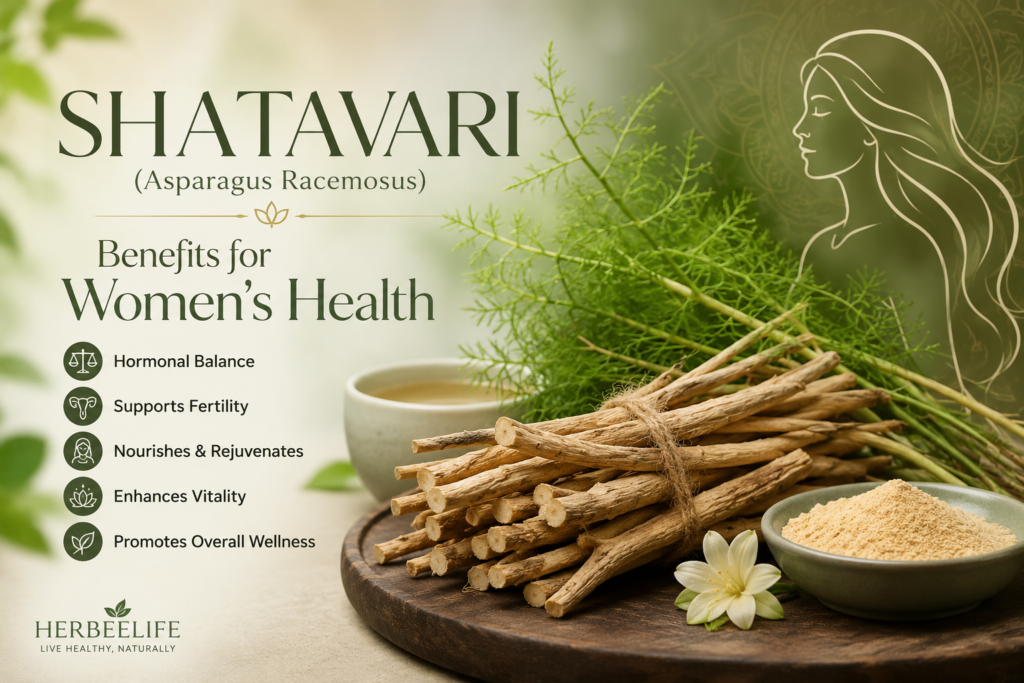
Shatavari Benefits for Women's Health
One of Ayurveda's most trusted herbs for women, from hormone balance to fertility support — what it actually does, and how to use it correctly.
Few herbs in Ayurveda are as closely tied to women's health as Shatavari. Its botanical name, Asparagus Racemosus, refers to a climbing plant native to India, whose root has been used for thousands of years to support everything from reproductive health to lactation to graceful aging.
This guide covers what Shatavari actually does, backed by both traditional use and modern interest, along with practical guidance on how and when to take it.
What's in a name? "Shatavari" is often translated as "she who possesses a hundred roots" or, more poetically, "she who has a hundred husbands" — a nod to the herb's traditional reputation for supporting vitality and reproductive strength across a woman's life stages.
Key Benefits of Shatavari
Hormone Balance
Traditionally used to support a more regular, balanced cycle
Lactation Support
One of the most common traditional uses for nursing mothers
Fertility
Considered a reproductive tonic in classical Ayurvedic texts
Menopause Support
Used to ease the transition through hormonal shifts
Digestive Health
Traditionally soothing for the digestive and gut lining
Immune Support
Classified as an adaptogen with general immune-supporting use
If hormone balance is your main focus, our broader guide on natural remedies for hormonal imbalance in females pairs well with this one.
Shatavari: Powder, Capsules, or Kalpa?
Using Shatavari the Right Way
When is the best time to take Shatavari?
Most commonly taken with warm milk in the morning or evening, on an empty stomach or as directed by an Ayurvedic practitioner, for consistent absorption.
What happens if you take Shatavari daily?
Used consistently over weeks to months, it's traditionally associated with gradual improvements in hormonal balance, digestion, and overall vitality — Ayurvedic herbs generally work cumulatively rather than instantly.
What should you not mix Shatavari with?
It's best not to combine it carelessly with other hormone-affecting supplements or medications without professional guidance, given its traditional use in supporting reproductive hormone balance.
How should women use Shatavari specifically?
Dosage and form often depend on the specific goal — fertility support, lactation, or menopause — which is why consulting an Ayurvedic practitioner for personalized guidance is genuinely worthwhile here.
If you're trying to conceive: Shatavari is often mentioned alongside dietary approaches to fertility. Our guide on the Ayurvedic diet for fertility covers this in more depth.
Shatavari Products Worth Considering
Here are seven ways to bring this herb into your routine, across different traditional and modern formats.
Shatavari Capsules (Standardized Extract)
A convenient, consistent daily option for those who prefer not to prepare a powder or tonic each day.
Check Price on AmazonShatavari Golden Milk Mix
A warming, traditional-style blend designed to be stirred into warm milk as a calming evening ritual.
Check Price on AmazonOrganic Dried Asparagus Racemosus Root
The whole, unprocessed root for those who prefer to prepare their own traditional decoctions.
Check Price on AmazonShatavari Medicated Ghee
A traditional Ayurvedic preparation often used postpartum or for deep nourishment during recovery.
Check Price on AmazonShatavari, Fennel & Fenugreek Lactation Tea
A traditional herbal blend combining three herbs commonly used to support breast milk supply.
Check Price on AmazonClassical Shatavari Kalpa Granules
A traditional granulated preparation, typically mixed with warm milk, following age-old Ayurvedic formulation.
Check Price on AmazonShatavari & Rose Petal Cooling Tonic
A gentle, cooling herbal tonic pairing Shatavari with rose, traditionally used to support balance during hormonal transitions.
Check Price on AmazonWho Should Be Cautious
Consult a doctor or Ayurvedic practitioner before use if you:
- Are pregnant — while traditionally used postpartum, prenatal use should only be under professional guidance
- Have a hormone-sensitive condition, since Shatavari may interact with hormonal balance
- Are taking hormonal medication or fertility treatments
- Have a known allergy to plants in the asparagus family
Shatavari has a long history of traditional use, but as with any herb affecting hormonal balance, personalized guidance matters more than a generic dosage found online.
Continue Reading on HerBeeLife
Join the HerBeeLife Community
Follow us for daily Ayurvedic wisdom, women's health guidance, and natural remedies.
Frequently Asked Questions
What is Shatavari also known as?
Shatavari is the common Ayurvedic name for the plant scientifically known as Asparagus Racemosus, a climbing plant native to India whose root is used medicinally.
What will happen if I take Shatavari daily?
Consistent daily use over weeks to months is traditionally associated with gradual support for hormonal balance, digestion, and overall vitality, since Ayurvedic herbs generally work cumulatively rather than producing immediate effects.
When is the best time to take Shatavari for women?
It's commonly taken with warm milk in the morning or evening. The ideal timing can depend on your specific goal, so guidance from an Ayurvedic practitioner is recommended for personalized use.
What should not be mixed with Shatavari?
Since Shatavari traditionally supports hormonal balance, it's best not to combine it with other hormone-affecting supplements or medications without consulting a healthcare provider first.
This article is for informational purposes only and is not a substitute for professional medical advice. Please consult a doctor or Ayurvedic practitioner before starting Shatavari, especially if pregnant, nursing, or on medication.