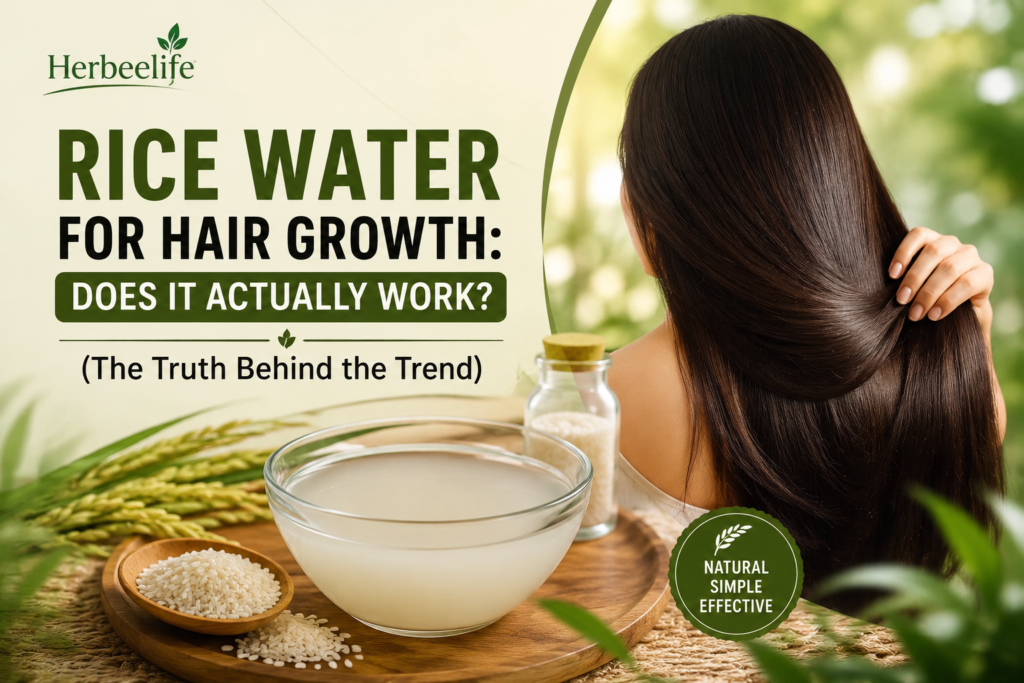

Rice Water for Hair Growth: Does It Actually Work?
Floor-length hair, viral TikToks, and one persistent question: is there real science behind it, or is it a case of mistaken identity between two very different rice products?
Quick Summary — What This Guide Covers
Most rice water hair-growth claims actually rely on studies of rice bran extract — a concentrated, processed ingredient — not the dilute starchy water you get from rinsing rice at home. We break down that mix-up, what inositol genuinely does for hair, the real clinical evidence, safety risks like protein overload, and an honest verdict on whether it's worth trying.
Why Rice Water Won't Leave Your Feed
The story behind rice water is genuinely compelling. In Huangluo village, China, the Yao women are famous for hair that reaches the floor — and local tradition credits fermented rice water rinses passed down for generations. It's the kind of origin story that makes a remedy irresistible to believe in.
But here's the question worth asking before you start saving your rice-rinse water in a jar: does rice water itself have clinical evidence behind it, or is the internet quietly borrowing evidence from a completely different rice product?
The honest answer is more interesting than a simple yes or no — and it explains a lot about why some people swear by it while dermatologists stay cautious.
Inositol — The Compound Everyone's Talking About
Rice water contains inositol, a sugar alcohol, along with small amounts of amino acids, B vitamins, and trace minerals like zinc and magnesium. Inositol is the ingredient most commonly cited to justify rice water's hair benefits, and there's genuine research behind part of that claim.
What inositol actually does, based on the evidence: it can penetrate damaged hair strands and reduce surface friction, which makes hair feel smoother, more elastic, and less prone to tangling and breakage. That's a real, meaningful benefit — especially for damaged or chemically treated hair.
Reducing friction and improving strand strength is not the same as stimulating new hair growth from the follicle. Those are two completely different mechanisms — one is cosmetic and structural, the other would require acting on the hair growth cycle itself.
The Mix-Up: Rice Water vs. Rice Bran Extract
This is the part almost every article on this topic skips, and it's the key to understanding the whole debate. When you see claims about rice studies showing real hair growth effects, they're almost always talking about rice bran extract — a concentrated compound derived from the outer hull of the rice grain — not the diluted water left over from rinsing whole rice grains at home.
A 2022 systematic review published in the Journal of Drugs in Dermatology examined the available research on rice products and hair growth. It found that rice bran extract shows promise for maintaining the hair growth (anagen) phase, inhibiting the enzyme that drives hormonal hair loss, and reducing scalp inflammation — but this evidence largely comes from animal and lab (in-vitro) studies, not humans, and the review noted only one of the ten studies it analyzed was actually conducted on people.
That one human study is worth a closer look: a 16-week double-blind randomized controlled trial tested a rice bran supercritical extract (a specially processed, concentrated form) applied daily and found it significantly increased hair density and diameter, with no adverse reactions reported.
| What You're Comparing | Rice Water (DIY) | Rice Bran Extract (studied) |
|---|---|---|
| What it is | Diluted starchy water from soaking/boiling whole rice | Concentrated compound extracted from the rice hull |
| Active compound levels | Low, unmeasured concentration | Standardized, concentrated for research use |
| Human clinical evidence | None published to date | One 16-week human RCT showing increased density |
| Best supported benefit | Smoothness, reduced friction, less breakage | Growth-factor expression, reduced hair loss (in that trial) |
In other words: the DIY rinse sitting in your kitchen is a genuinely different product from what was actually tested for hair growth. Nobody has measured exactly how much inositol or active compound ends up in a home-brewed batch of rice water, which makes it difficult to say the growth-related findings transfer over.
So Does Rice Water Work for Hair Growth?
Based on the current evidence: no published clinical trial has shown that rinsing your hair in home-brewed rice water grows new hair or reverses thinning. What it can genuinely do is make existing hair look and feel healthier — smoother, shinier, more elastic, and less prone to breakage.
That's not nothing. Less breakage means you retain more of the length you already have, which can create the appearance of faster growth over time, even without any actual increase in follicle activity. If your main concern is damaged or brittle hair rather than a genuine growth issue, rice water is a low-risk addition worth trying.
Reducing friction and breakage, adding shine, improving manageability for damaged or chemically treated hair — as a rinse addition, not a growth treatment.
Rice Water Claims That Need a Reality Check
Rice water is clinically proven to regrow hair.
The growth-related research is on rice bran extract, a different, concentrated product — not the diluted rinse water made at home.
Fermenting rice water makes it dramatically more powerful.
Fermentation slightly raises inositol concentration and lowers pH, which may help close the hair cuticle — but it doesn't turn it into a growth treatment.
More rice water, used more often, means faster results.
Overuse can cause "protein overload" — a real condition where hair becomes stiff, brittle, and prone to breakage from too much protein exposure without enough moisture balance.
The Yao women's floor-length hair proves rice water works.
Their hair health likely reflects genetics, diet, minimal chemical processing, and lifestyle factors — not rice water alone. It's a compelling tradition, not a controlled experiment.
How to Use Rice Water Safely (Without Overdoing It)
Make Plain or Fermented Rice Water
Soak half a cup of uncooked rice in 2-3 cups of water for 30 minutes, then strain. For a fermented version, let the strained water sit at room temperature for 24-48 hours before use — this slightly increases inositol concentration and lowers pH.
Use It as a Post-Shampoo Rinse
After shampooing, pour rice water through your hair and scalp, focusing on the lengths and ends rather than saturating the roots.
Leave On for 10-20 Minutes, Then Rinse Thoroughly
A final rinse with plain water helps prevent residue buildup and reduces the risk of protein overload from repeated, unwashed use.
Limit to 1-2 Times a Week
Using it more frequently doesn't speed up results and raises the risk of over-proteinizing your hair, which can leave it feeling straw-like and prone to snapping.
If your hair starts feeling stiff, dry, or unusually brittle after a few weeks of use, cut back frequency and follow up with a moisture-focused conditioner. This is a real, commonly reported side effect of overusing protein-rich rinses like rice water.
Formulated Rice Water Products Worth Trying
If straining rice water at home isn't practical for your routine, formulated products deliver a pre-balanced version alongside other beneficial ingredients like keratin — which can help offset the protein-overload risk of using rice water alone.
Mamaearth Rice Water Shampoo with Keratin
A sulfate- and paraben-free shampoo built around fermented rice water and keratin, aimed at reducing split ends and breakage. A practical starting point if you want the smoothness benefit without preparing fresh rice water each week.
👉 Check Price on Amazon → 📢 Disclosure: This is an affiliate link. HerbeeLife earns a small commission if you purchase — at no extra cost to you. We only recommend products we genuinely believe in.
Mamaearth Rice Water Conditioner with Keratin
Pairs with the shampoo above to lock in moisture after cleansing — helps counter the dryness that can come from protein-heavy rice water treatments used alone.
👉 Check Price on Amazon → 📢 Disclosure: This is an affiliate link. HerbeeLife earns a small commission if you purchase — at no extra cost to you.
Frequently Asked Questions About Rice Water for Hair
Does rice water really help hair grow faster?
No published clinical trial has shown that home-brewed rice water increases hair growth rate. The growth-related evidence that exists is for rice bran extract, a different, concentrated ingredient.
Is fermented rice water better than plain rice water?
Fermented rice water has a slightly higher inositol concentration and lower pH, which may help smooth the hair cuticle more effectively. Neither version has evidence for stimulating new growth.
Can rice water cause hair damage?
Yes, with overuse. Rice water is protein-rich, and applying it too frequently without balancing moisture can cause "protein overload" — stiff, brittle, breakage-prone hair. Limit use to 1-2 times a week.
How long does it take to see results from rice water?
Improvements in smoothness and reduced breakage are often noticeable within a few uses, since these are surface-level effects. There's no established timeline for growth-related results, since growth hasn't been demonstrated in human trials.
Is rice water safe for color-treated hair?
Generally yes, since it's a mild, chemical-free rinse — but as with any new treatment, patch test first and watch for excessive dryness or stiffness with repeated use.
A Quick Disclaimer
This article is for general informational purposes and reflects published research alongside traditional use. It isn't a substitute for professional medical advice. If you're experiencing significant hair thinning or hair loss, please consult a dermatologist to identify the underlying cause before relying on home remedies.
Get Daily Natural Hair & Skin Tips
We share quick remedies, honest product breakdowns, and Ayurvedic tips regularly across our social pages.
You Might Also Find These Helpful
15 Best Home Remedies for Hair Fall
The full list of remedies ranked by evidence, with an honest myth vs. fact breakdown.
🧅Hair Fall After 30 Women
9 Alarming Causes You Must Stop Ignoring
💆♀️Moringa for Hair Growth
Science-Backed Benefits, Uses & 12-Week Results (2026)
🥗Homemade Hair Oil for Hair Fall
8 Science-Backed Recipes That Actually Regrow Hair
📝 Note: Double-check these related post URLs match your actual published articles before publishing.
Research & Clinical Evidence
- 📖 Hashemi K et al. — A Systematic Review: Application of Rice Products for Hair Growth (Journal of Drugs in Dermatology, 2022)
- 📖 Kang JI et al. — Safety and Efficacy of Rice Bran Supercritical CO2 Extract for Hair Growth in Androgenic Alopecia: A 16-Week Double-Blind RCT
- 📖 Cleveland Clinic — The Benefits of Using Rice Water on Your Hair
Have You Tried Rice Water on Your Hair? 🍚
Whether it made your hair smoother, did nothing noticeable, or left it feeling stiff — we'd love the honest version. Drop a comment below and tell us how long you used it and what you noticed. It genuinely helps other readers set realistic expectations. 💬
Want More Honest, Research-Backed Hair Guides Like This?
HerbeeLife breaks down natural remedies with the actual evidence behind them — no miracle-cure promises, just the honest picture.
🌿 Explore HerbeeLife → 📸 Follow on Instagram