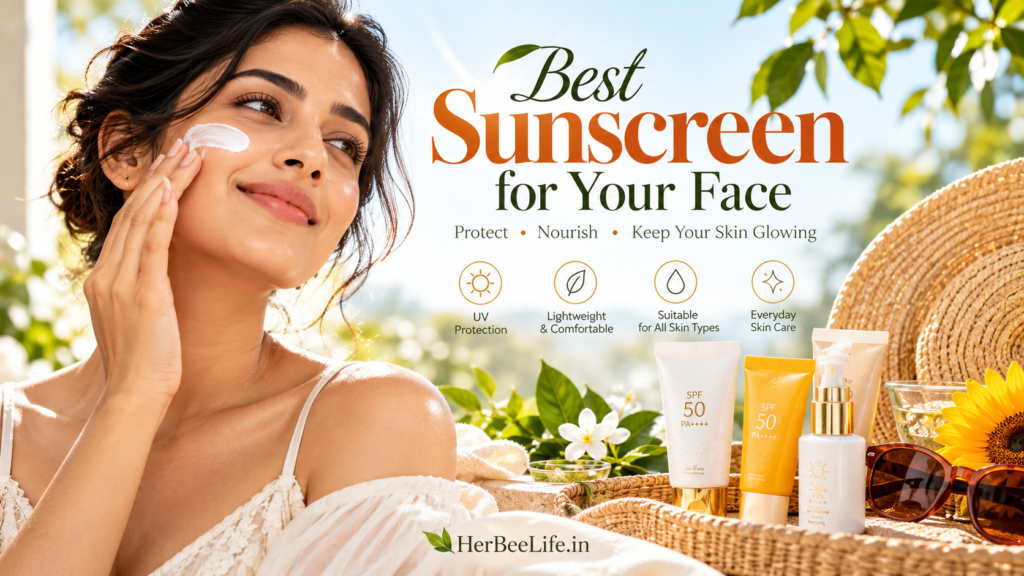

Sunscreen is the one product in your entire routine that dermatologists never disagree about. Everything else — cleansers, serums, night creams — has room for debate. Daily broad-spectrum protection doesn't. This is a complete, skin-type-by-skin-type guide to choosing the right sunscreen, understanding what SPF and PA ratings actually mean, and pairing it with the Ayurvedic home remedies that support skin health from the inside too.
In This Guide
Why Sunscreen Isn't Optional
Sun exposure is responsible for the vast majority of visible skin aging — far more than time itself. Beyond wrinkles and pigmentation, UV rays are also the leading preventable cause of skin cancer, which makes daily sunscreen one of the very few skincare steps with genuine, unambiguous long-term payoff.
| Ray Type | What It Does | Depth of Damage |
|---|---|---|
| UVA | Penetrates deeply, breaks down collagen, drives premature aging and pigmentation | Reaches deep dermis; passes through glass and clouds |
| UVB | Causes sunburn and is the primary driver of skin cancer risk | Affects the surface epidermis mainly |
SPF & PA Ratings, Explained Simply
SPF measures protection against UVB rays specifically — SPF 30 blocks about 97% of UVB rays, while SPF 50 blocks around 98%, a smaller jump than the numbers suggest. PA ratings (PA+ through PA++++), common on Asian sunscreen formulas, measure UVA protection separately — always look for "broad-spectrum" on the label to ensure both are genuinely covered.
I am a sunblock fanatic — I don't go out of my house a day without it, and I stash it in my car so there's never an excuse to skip it.
— Charlize Theron, Academy Award-Winning ActressMineral vs Chemical Sunscreen
Mineral (Physical)
- Sits on skin and physically reflects UV rays
- Generally gentler for sensitive and reactive skin
- Works immediately on application, no wait time
- Can sometimes leave a lighter cast on deeper skin tones
Chemical
- Absorbs UV rays and converts them to heat
- Typically lighter, more cosmetically elegant textures
- Needs about 15-20 minutes to become effective
- Occasionally causes stinging around the eyes for some users
The Right Sunscreen for Your Skin Type
The single biggest reason people quit wearing sunscreen isn't laziness — it's using a formula that fights their skin type. Here's how to match correctly.
For Dry Skin
HydratingLook for a sunscreen that doubles as a moisturizer, built with ceramides or DNA-repair actives that support an already-compromised barrier while protecting it further.
Isdin Eryfotona Ceramissime SPF 50 →For Oily & Acne-Prone Skin
Ultra-LightA watery, gel-like essence texture absorbs almost instantly, leaving zero greasy residue behind — a cult-favorite among people who've given up on sunscreen because "it always breaks me out."
Biore UV Aqua Rich Watery Essence SPF 50 →For Sensitive & Reactive Skin
Fragrance-FreeA gentle mineral fluid formulated for skin that reacts to almost everything, from a trusted French pharmacy brand built specifically around sensitivity.
Avène Mineral Fluid SPF 50+ →For Normal & Combination Skin
Invisible FinishAn oil-free, weightless gel that disappears into skin without any white cast or shine — genuinely wearable under makeup, every single day.
Supergoop! Unseen Sunscreen SPF 40 →For a Clean, Mineral-First Formula
Reef-SafeBuilt without chemical UV filters, this is a solid choice for anyone prioritizing a cleaner ingredient list without sacrificing broad-spectrum protection.
Coola Classic Face SPF 30 Mineral Sunscreen →For On-the-Go Reapplication
Travel-FriendlyA mess-free stick format makes reapplying over makeup during the day genuinely effortless — the single biggest reason most people skip reapplication is friction, and this removes it.
Peter Thomas Roth Max Mineral Melt-Proof Sunscreen Stick SPF 45 →For Deeper, Melanin-Rich Skin Tones
No White CastSpecifically formulated to blend invisibly into deeper skin tones, addressing a gap most mainstream mineral sunscreens leave unsolved — and a reminder that darker skin needs daily SPF every bit as much as fair skin does.
Black Girl Sunscreen SPF 30 →Once sunscreen is locked into your routine, it pairs naturally with the rest of your skincare — our daily skincare routine guide shows exactly where it fits in your morning sequence, and our anti-aging products guide explains why sunscreen is the single step that protects every other anti-aging effort you make. If dark circles or pigmentation are a concern too, our guide on removing dark circles naturally covers how sun exposure factors in there as well.
How Much to Apply & When
Most people apply roughly half the amount needed for full protection. A nickel-sized amount (about a quarter teaspoon) covers the face and neck properly. Apply as the final step of your morning routine, after moisturizer and before makeup, 15-20 minutes before heading outside if using a chemical formula. Reapply every two hours when outdoors, or after swimming and heavy sweating — a stick or powder format makes this realistic over makeup.
Sunscreen Myths, Debunked
Fact: Up to 80% of UV rays pass through cloud cover, so overcast skies offer far less protection than they appear to.
Fact: Melanin offers some natural protection but nowhere near enough to prevent UV damage, premature aging, or skin cancer risk.
Fact: Most people don't apply nearly enough foundation or powder to reach the labeled SPF — a dedicated sunscreen underneath is still necessary.
Fact: SPF measures strength of protection, not duration — even SPF 100 needs reapplying roughly every two hours in direct sun.
🌿 More sun-smart skincare, Ayurvedic wisdom, and honest product picks — follow along
Pinterest Instagram FacebookCommon Mistakes That Undo Good Sunscreen Habits
Applying sunscreen only on beach days rather than daily is the single biggest gap — most UV damage accumulates from ordinary daily exposure, not vacations. Skipping the ears, neck, and hands is another common miss, since these areas show sun damage early. And storing sunscreen in a hot car degrades its active ingredients faster than the expiration date suggests, so a cool, dry storage spot genuinely matters.
Frequently Asked Questions
Do I need sunscreen indoors or on cloudy days?
Yes. UVA rays pass through both windows and cloud cover, meaning meaningful UV exposure still reaches your skin even when you're indoors or the sky looks overcast.
What's the minimum SPF I should use daily?
Dermatologists generally recommend SPF 30 or higher for daily use, with broad-spectrum protection against both UVA and UVB rays being just as important as the SPF number itself.
Is mineral sunscreen genuinely better than chemical sunscreen?
Neither is universally better — mineral formulas tend to suit sensitive skin best, while chemical formulas often offer lighter, more cosmetically elegant textures. The best sunscreen is the one you'll actually wear every day.
Can sunscreen cause breakouts?
Some heavier formulas can clog pores on acne-prone skin, but many modern gel and fluid textures are specifically designed to be non-comedogenic, so breakouts are more about formula choice than sunscreen itself.
How often should sunscreen actually be reapplied?
Every two hours when outdoors in direct sun, and immediately after swimming or heavy sweating, regardless of how high the SPF number on the bottle is.