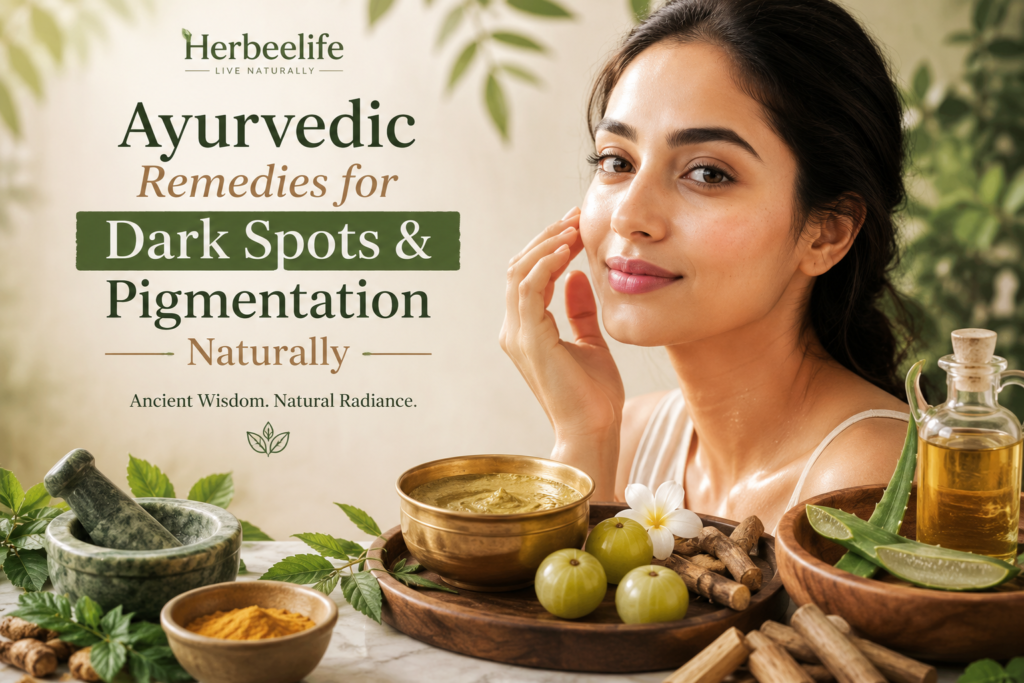

Ayurvedic Remedies for Dark Spots and Pigmentation That Actually Fade Them
A deep-dive into the ancient science of skin brightening — 12 clinically-informed, Ayurveda-rooted remedies for hyperpigmentation, dark spots, melasma, and uneven skin tone, curated for the Indian skin type.
You have tried every brightening cream. You have patted on Vitamin C serums and religiously applied SPF. Yet those stubborn dark patches on your cheekbones, that post-pimple mark that refuses to leave, or the uneven skin tone that no filter truly fixes — they persist.
Here is the thing that modern skincare marketing rarely tells you: pigmentation is not a surface problem. It is a systemic one. And Ayurveda — a 5,000-year-old science of life — understood this long before dermatology had the language to explain it. Melanin overproduction is triggered by inflammation, hormonal imbalance, liver toxicity, and oxidative stress. Ayurveda targets all four.
At HerbeeLife, we have combined classical Ayurvedic formulations with what modern dermatological research says about each ingredient to give you a guide that is beautiful in its depth and practical in its application. If skin is your canvas, Ayurveda is the most sophisticated paintbrush you own.
Pigmentation — the umbrella term for dark spots, hyperpigmentation, melasma, and uneven skin tone — results from an overproduction of melanin by skin cells called melanocytes. Triggers include UV exposure, hormonal fluctuations (especially estrogen spikes during pregnancy or with oral contraceptives), post-inflammatory responses (acne scars, wounds), stress, liver function decline, and chronic oxidative damage. In Ayurveda, this is a Pitta-Vata imbalance — Pitta drives inflammation and Vata disturbs cellular renewal, together resulting in uneven, dull, and spotted skin.
- Kumkumadi Tailam (Saffron Face Oil)
- Manjishtha (Indian Madder)
- Turmeric & Raw Honey Mask
- Amla — Internal & External
- Chandan (Sandalwood)
- Neem & Aloe Vera Duo
- Haldi + Kesar Face Paste
- Raw Papaya Enzyme Mask
- Mulethi (Licorice Root) Serum
- Triphala Skin Detox
- Rose Water & Vetiver Toner
- Ashwagandha — The Stress–Skin Link
- Premium Ayurvedic Products
- Your 4-Step Daily Routine
- FAQs
First: Know Your Skin's Root Imbalance
In Ayurveda, every skin condition has a dosha root — and treating skin without identifying your dosha type is like watering a plant without knowing what it needs. Pigmentation typically involves all three, but one usually dominates:
Vata Skin
Dry, thin, rough texture. Tends toward dark under-eye circles, dull patches, and premature fine lines around dark spots. Needs deep nourishment — oils like Kumkumadi work beautifully.
Pitta Skin ✦ Most Common
Sensitive, prone to inflammation, redness, and freckles. Sun exposure triggers rapid melanin overproduction. Classic melasma and post-acne hyperpigmentation. Needs cooling, anti-inflammatory herbs: Manjishtha, Chandan, Mulethi.
Kapha Skin
Oily, thick, prone to congestion. Dark spots tend to appear more superficially and respond well to exfoliation and cleansing herbs: Neem, Turmeric, Triphala.
Don't worry if you don't know your dominant dosha — the remedies below are formulated to benefit all skin types. We recommend reading our companion article on natural skincare ingredients that actually work for a broader framework of Ayurvedic skin science.
12 Ayurvedic Remedies for Dark Spots & Pigmentation
✨ Kumkumadi Tailam (Saffron Face Oil)
If there is one Ayurvedic formulation that has survived 3,000 years of skin-care practice and is now confirmed by modern dermatology to be genuinely effective, it is Kumkumadi Tailam. First documented in the Ashtanga Hridayam, this oil combines over 25 rare herbs in a sesame oil base, with saffron (kumkuma) as the hero ingredient.
Saffron contains crocin and safranal — potent antioxidants that inhibit melanin synthesis at the melanocyte level and reduce tyrosinase activity (the enzyme responsible for melanin production). Manjishtha purifies the blood and lymph, removing the internal toxins that manifest as pigmentation. Together, this oil addresses dark spots from the outside while simultaneously detoxifying the system from within.
Research: A 2016 study found saffron significantly reduced melanin index in subjects with hyperpigmentation after 8 weeks of topical application. The formula pairs saffron's brightening action with red sandalwood's anti-inflammatory and mulethi's melanin-inhibiting glycyrrhizin for cumulative, synergistic brightening.
After double cleansing, take 3-4 drops of Kumkumadi Tailam onto your fingertips. Press gently onto the face — never rub — focusing on dark spots, forehead pigmentation, and cheeks. Massage in upward, circular motions for 3-5 minutes to promote lymphatic drainage and absorption. Leave overnight. Start with every alternate night if you have sensitive or oily skin, then build to nightly use. Always follow with SPF the next morning.
Kama Ayurveda Kumkumadi Youth-Revitalising Facial Oil (12ml / 30ml)
Arguably the most prestigious Kumkumadi Tailam available in India. Kama Ayurveda crafts each bottle with Grade I Mongra Saffron from Pampore, Kashmir — the most potent saffron variant in the world, rich in phytoactive crocin. Clinically proven for 92% brighter skin, with 3× more regenerating Vitamin A than conventional Kumkumadi oils. Cold-processed, pure, and certified authentic. Favoured by editorial stylists and Ayurvedic practitioners alike. This is not a luxury indulgence — it is the closest thing to prescription-grade skin brightening you will find in a jar.
🌺 Manjishtha (Indian Madder / Rubia cordifolia)
Manjishtha is the single most important herb in Ayurveda for skin pigmentation — and the one most Western skincare brands are quietly incorporating under its scientific name. It is classified as a Varnya herb in classical texts — directly translating to "that which gives complexion." Its active compound purpurin inhibits tyrosinase, the key enzyme in melanin synthesis, while its anti-inflammatory properties reduce post-acne dark marks before they can deepen.
What makes Manjishtha unique is its dual action: it works both internally (blood purification, lymphatic cleansing) and externally (melanin inhibition, antioxidant protection). Pigmentation that is rooted in hormonal imbalance or liver toxicity responds particularly well to internal Manjishtha supplementation.
For a deeper understanding of how blood purity connects to skin radiance, our article on Neem benefits for blood purification is a fascinating companion read — the two herbs are often used together in classical formulas.
Internal: 500mg Manjishtha powder twice daily in warm water, 30 minutes before meals. Build for 8-12 weeks. Topical mask: Mix 1 tsp Manjishtha powder + 1 tsp raw honey + 3 drops rose water into a smooth paste. Apply to clean face for 15-20 minutes. Rinse with cool water. Use 3× weekly. Note: Manjishtha can stain — use an old pillowcase when using the oil at night.
💛 Turmeric & Raw Honey Brightening Mask
Turmeric — or Haridra in Sanskrit — has more peer-reviewed studies on its skin benefits than almost any other natural ingredient. The active compound curcumin is a potent tyrosinase inhibitor, reducing melanin production at the cellular level. A 2013 study in Phytotherapy Research found that topical curcumin significantly reduced facial hyperpigmentation compared to placebo in 8 weeks.
Raw honey acts as a humectant (draws moisture into skin) and contains natural hydrogen peroxide and enzymes that gently exfoliate dead skin cells — the combination with turmeric creates a mask that brightens, hydrates, and reduces inflammation simultaneously. Our comprehensive guide on health benefits of turmeric covers the systemic skin benefits of this golden root in remarkable detail.
Mix ¼ tsp organic raw turmeric powder (not yellow food-colouring grade) + 1 tsp raw forest honey + 2 drops of rose water. Blend into a smooth, spreadable paste. Apply to cleansed face, avoiding eye area. Leave for 15-20 minutes, then rinse with lukewarm water. Use twice weekly. Use Kasturi turmeric (Curcuma aromatica) if staining is a concern — it has the same active compounds but does not leave a yellow tinge.
"The skin is not a mask to be covered — it is a mirror to the health of everything that lies beneath."
— Charaka Samhita, Classical Ayurvedic Text, c. 600 BCE💚 Amla — The Inside-Out Brightening Secret
Amla is the richest natural source of Vitamin C on Earth — containing approximately 600-700mg per 100g, compared to orange's 50mg. This is not incidental: Vitamin C is the most clinically proven ingredient for reducing hyperpigmentation, inhibiting melanin synthesis, and stimulating collagen production that fills in the textural marks left by dark spots.
But Amla's skin benefits extend beyond its Vitamin C content. Its emblicanin A and B tannins are powerful antioxidants that protect existing melanocytes from UV-induced DNA damage — preventing new spots while fading old ones. Used both internally and externally, Amla is one of the most well-rounded skin brightening agents in all of traditional medicine. Our thorough piece on Amla benefits covers the full spectrum of this extraordinary fruit.
Internal: 20-30ml fresh Amla juice in water each morning on an empty stomach, or 2 fresh Amlas daily. Topical: Apply fresh Amla juice directly to dark spots with a cotton pad. Leave for 15 minutes, rinse. Alternatively, mix Amla powder with rose water into a paste and apply as a 20-minute mask three times weekly. Results become visible in 6-8 weeks of consistent use.
Forest Essentials Tejasvi Brightening Ghee Cream — Pigmentation & Dark Patches (50g)
Forest Essentials is India's most celebrated luxury Ayurvedic skincare brand, with the distinction of being the first to bring true Ayurvedic formulations to the prestige skincare segment. Their Tejasvi Brightening Ghee Cream is a landmark product — formulated with aged cow's ghee (which rebuilds collagen), saffron, and a proprietary blend of Varnya herbs from the Charaka Samhita. It lightens pigmentation and dark patches while deeply nourishing the skin barrier, leaving a lit-from-within glow that no chemical brightener can quite replicate. Handcrafted in small batches; a genuine luxury.
🪵 Chandan (Sandalwood) — Pitta's Best Friend
White Sandalwood — Shweta Chandan — is one of the most revered skin-care ingredients in Ayurvedic beauty. Its primary active compound, alpha-santalol, has been shown in studies to inhibit the proliferation of melanocytes under UV stimulation, making it particularly effective for sun-induced dark spots and tanning. Its cooling, Pitta-pacifying properties reduce the inflammation that triggers post-acne pigmentation.
Sandalwood's astringent tannins also tighten pores, improve skin texture, and reduce the redness that makes dark spots appear more pronounced. It is a deeply calming ingredient for sensitive, reactive skin types — the kind that tends to develop inflammation-driven hyperpigmentation at the slightest trigger.
Mix 1 tsp pure white sandalwood powder + ½ tsp turmeric + enough rose water to make a smooth paste. Apply to pigmented areas for 20-25 minutes. Rinse gently. This is one of the oldest bridal beauty rituals in India — used for centuries to even out skin tone before weddings. Use three times weekly for visible results in 4-6 weeks.
🍃 Neem & Aloe Vera — The Detox Duo
Neem is Ayurveda's most powerful blood and skin purifier. Its compound nimbidin reduces sebum oxidation — the process that turns ordinary oil into the dark, pore-clogging material that creates post-acne marks. Quercetin in neem is a direct melanin inhibitor. When combined with aloe vera's aloin compound (a natural depigmenting agent studied since the 1980s), you get a mask that works on both the root cause (bacterial inflammation) and the resulting mark (melanin deposit) simultaneously.
Our detailed exploration of Neem's blood purification benefits explains why internal neem use — capsules or juice — can accelerate the clearance of pigmentation that has hormonal or metabolic roots. Clear blood means clear skin: Ayurveda has insisted on this link for millennia.
Blend 1 tsp neem powder + 2 tbsp fresh aloe vera gel + 2 drops tea tree essential oil into a paste. Apply a thin layer to pigmented areas (avoid under-eye). Leave for 15 minutes. Rinse with cool water. Use two to three times weekly. For internal use: 2 neem capsules (500mg each) after meals, combined with 30ml aloe vera juice in the morning.
Gynoveda Ayurvedic Solution for Pigmentation & Dark Spots — Haldi & Kesar Formula (240 Tablets + Face Jar)
Gynoveda is one of India's most trusted women's wellness brands, known for combining authentic Ayurvedic herb science with modern pharmaceutical quality control. Their pigmentation solution addresses the hormonal root cause — working from the inside out with Haldi (curcumin), Kesar (crocin), and Manjishtha to systematically reduce melanin overproduction over a full hormonal cycle. The simultaneous topical jar completes the dual-action protocol. A premium, doctor-formulated choice for women whose dark spots are linked to hormonal changes, PCOD, or post-pregnancy melasma.
💛🟠 Haldi + Kesar (Turmeric + Saffron) Face Paste
This is perhaps the oldest skin brightening ritual in the Indian subcontinent — the haldi rasam performed before every traditional wedding is not merely cultural ceremony. It is an evidence-based skin intervention. Saffron's crocin and crocetin compounds are among the most potent natural tyrosinase inhibitors known, directly suppressing the production of new melanin. Combined with turmeric's curcumin — which reduces inflammation that triggers melanin production — and raw milk's lactic acid (a gentle natural exfoliant) this paste has a triple mechanism of action.
Dissolve 8-10 saffron strands in 1 tbsp warm raw milk for 15 minutes until the milk turns golden. Add ¼ tsp turmeric and 1 tsp besan (gram flour). Mix into a smooth paste. Apply to face and neck in gentle circular motions. Leave for 20-30 minutes until the paste dries lightly. Rinse with cool water, using the crumbled paste as a mild exfoliant. Use twice weekly. This is one of the best remedies for melasma on the cheeks and forehead.
🍈 Raw Papaya Enzyme Mask
Raw papaya contains papain — a proteolytic enzyme that breaks down the dead, pigmented keratinocytes sitting on the skin's surface, effectively exfoliating away the darkened upper layer of skin to reveal newer, less pigmented cells beneath. This is chemical exfoliation without chemicals, and it is remarkably effective for superficial hyperpigmentation and sun tanning.
The combination of papain's surface action and Vitamin A's cellular renewal stimulation deep in the dermis makes raw papaya one of the most complete brightening agents available. Ripe papaya also works, but raw papaya contains higher papain concentration. If you're exploring how diet contributes to skin glow, our guide on superfoods for glowing skin is essential reading.
Mash ¼ cup raw papaya flesh into a smooth paste. Apply to cleansed face. Leave for 10-15 minutes — no longer with raw papaya, as the enzymes can over-exfoliate. Rinse well with cool water. Follow with a gentle moisturiser. Use twice weekly. For sensitive skin, mix papaya with aloe vera gel (1:1) to dilute the enzyme concentration. Always patch-test on the inner wrist first.
🪵 Mulethi (Licorice Root) — Dermatology's Ayurvedic Secret
Mulethi is the ingredient that bridged Ayurveda and modern cosmetic dermatology most convincingly. Its compound glabridin is one of the most studied natural skin brightening agents, shown in multiple controlled trials to inhibit UVB-induced pigmentation and reduce existing hyperpigmentation without the irritation associated with chemical alternatives like hydroquinone.
Liquiritin, another compound in Mulethi, disperses existing melanin deposits by disrupting the melanin transfer mechanism — meaning it not only prevents new spots but actively fades existing ones. It is used extensively in Korean skincare formulations under the name "licorice extract." In Ayurveda, it has been classified as a top-tier Varnya (complexion-enhancing) herb for millennia. This is convergent wisdom across two completely independent traditions of skin science.
Mix 1 tsp Mulethi powder in 2 tbsp rose water. Stir well and strain through a fine cloth. Apply to dark spots using a cotton pad, morning and evening, before your moisturiser. Let it absorb completely before applying SPF. For a more potent mask: mix Mulethi powder + yogurt + a few drops of lemon juice into a paste. Apply for 20 minutes, twice weekly.
iYURA Kesaradi Face Oil — Saffron-Rich Ayurvedic Face Moisturizer for Brighter Skin (50ml)
iYURA is an internationally respected Ayurvedic beauty brand known for authenticating every formulation against classical Sanskrit texts. Kesaradi is their cult face oil — a precision-crafted blend of saffron, 17 rare Ayurvedic botanicals, and cold-pressed oils specifically formulated for dull, uneven, pigmented skin. It is lightweight enough for Indian climate year-round, absorbs beautifully, and delivers the kind of gradual, glass-skin luminosity that only genuine saffron can produce. Dermatologist-recommended for hyperpigmentation-prone skin. A real investment in your skin's future.
🌿 Triphala — Clear Gut, Clear Skin
In Ayurveda, there is a fundamental principle: Rasa dushti — impurity of the plasma tissue — is the root cause of most skin conditions, including pigmentation. The gut is where rasa (plasma) is produced. When the gut is inflamed, toxic, or functioning poorly, the blood carries those toxins to the skin — manifesting as uneven tone, dullness, and persistent dark marks.
Triphala — the three-fruit formula of Amla, Haritaki, and Bibhitaki — is Ayurveda's most celebrated gut detoxifier. Clinical studies confirm its prebiotic effect, anti-inflammatory activity, and ability to reduce oxidative stress markers. Clearing gut toxins through Triphala is often the missing piece for people whose topical skin treatments produce only partial results. For a full breakdown of this formulation, see our Ayurvedic remedies for gut health article.
Take ½ tsp Triphala powder in warm water 30-60 minutes before bed. This allows overnight detoxification via the digestive and lymphatic channels. Also effective as a skin wash: brew Triphala tea (1 tsp powder in 2 cups water, simmer 10 minutes, cool, strain), then use as a toner or face wash. The tannins in Triphala gently brighten and tighten on contact.
🌹 Rose Water & Vetiver — The Toning Duo
Pure rose water — not the synthetic floral water in most drugstore bottles, but cold-pressed or steam-distilled rose hydrosol — is extraordinarily rich in phenols, tannins, and anthocyanins that cumulatively protect melanocytes from UV-triggered overactivation. Used as a daily toner, it restores the skin's natural pH (which is slightly acidic at 4.5-5.5), and an unbalanced, alkaline skin surface is more vulnerable to pigmentation triggers.
Vetiver (Ushira in Ayurveda) is a cooling root that prevents Pitta-driven skin inflammation. Combined, this toner duo prepares the skin optimally for the active ingredients that follow — it is the base protocol onto which every other remedy builds. This pairs beautifully with the home remedies for glowing skin routine we've built at HerbeeLife.
Soak 5-6 dried vetiver roots in 200ml pure rose water overnight. Strain in the morning. Transfer to a spray bottle. Use as a face mist morning and evening, after cleansing and before applying oils or moisturiser. You can also soak a cotton pad and gently press it onto pigmented areas for 2-3 minutes as a targeted toning treatment. Keep refrigerated and use within 5-7 days.
🌿 Ashwagandha — The Cortisol–Pigmentation Link
Chronic stress is one of the most overlooked triggers of hyperpigmentation. Elevated cortisol stimulates the HPA axis to increase ACTH (adrenocorticotropic hormone), which directly upregulates melanocyte-stimulating hormone (MSH) — accelerating melanin production. This is why melasma often worsens during periods of stress, and why some pigmentation does not respond to topical treatment alone.
Ashwagandha's withanolides are clinically proven to reduce serum cortisol by up to 27.9% in 60 days (a 2012 randomised double-blind trial). Lower cortisol means lower MSH, which means reduced melanin stimulation from the inside. It also supports collagen synthesis — the scaffolding that gives skin its texture and firmness — which is often damaged in chronically pigmented areas. Our article on Ashwagandha benefits for stress and anxiety is essential reading if you suspect stress is driving your skin concerns.
300-600mg standardised Ashwagandha root extract (KSM-66 or Sensoril form) at night with warm milk or water. Build consistently for 60-90 days minimum. This is not a topical remedy — its brightening effect comes entirely from reducing the cortisol-MSH-melanin cascade systemically. Pair with the topical remedies above for a comprehensive, dual-front approach to pigmentation.
Premium Ayurvedic Skin Products Worth the Investment
The remedies above are powerful as DIY rituals. For those who want the precision, purity, and convenience of professionally formulated Ayurvedic products — particularly when dealing with stubborn or deep-set pigmentation — these are our curated premium picks from Amazon.
Auravedic Kumkumadi Tailam Pure Saffron Ultra Brightening Face Oil with 20+ Herbs (100ml)
Auravedic has earned consistent acclaim for formulating authentic Kumkumadi Tailam that stays closest to the original Ashtanga Hridayam prescription. This 100ml bottle contains saffron and over 20 Ayurvedic herbs — Manjishtha, Red Sandalwood, Lotus, Vetiver — in a cold-processed sesame base that absorbs without greasiness. Independently reviewed by skincare experts as one of the most effective Kumkumadi products in the Indian premium market. Particularly effective for dark spots and uneven tone from sun damage, hormonal shifts, and post-acne marks.
Kerala Ayurveda Kumkumadi Oil for Face — Brightening & Anti-Aging Saffron Serum (30ml)
Kerala Ayurveda is one of India's oldest and most respected authentic Ayurvedic institutions, with over 75 years of clinical practice in the Kerala Pancha Karma tradition. Their Kumkumadi Oil is formulated by qualified Ayurvedic physicians, using a cold-pressed saffron-sesame base enriched with Lotus and Padmaka. It is lightweight, non-comedogenic, and has a particularly faithful adherence to classical proportions. For those who want guaranteed pedigree in their Ayurvedic skincare — Kerala Ayurveda delivers institutional authenticity that consumer brands rarely match.
Kottakkal Arya Vaidya Sala Nalpamaradi Keratailam (200ml) — Heritage Skin Brightening Oil
Kottakkal Arya Vaidya Sala is not a beauty brand — it is a 120-year-old Ayurvedic institution of the highest international repute, producing genuine classical formulations that have passed through generations of Vaidyas (Ayurvedic physicians). Nalpamaradi Keratailam is their heritage skin brightening formula — a coconut oil-based tailam with four types of fig tree barks, turmeric, and sesame — classically used for tanning, dark patches, and improving overall skin lustre. This is prescription-grade Ayurvedic skincare. If authenticity and lineage matter to you in your skincare, nothing on this list has deeper roots.
Your Ayurvedic Anti-Pigmentation Daily Routine
Individual remedies work. A systematic, daily routine transforms skin. Here is a complete morning-to-night Ayurvedic protocol for reducing dark spots and pigmentation, drawing from the science above:
20-30ml Amla juice + warm water. Take Ashwagandha (300mg) with warm milk. This sets the systemic anti-pigmentation environment for the day.
Apply Vetiver-Rose Water toner with a cotton pad. Allow to absorb. Apply Mulethi water (or serum) to dark spots. Finish with SPF 50 — non-negotiable. Sun protection prevents all future pigmentation triggers and protects your night-time repair work.
Alternate between the Haldi-Kesar paste (Tuesdays, Fridays) and the Turmeric-Honey mask (Thursdays). Rinse before SPF application.
Double cleanse to remove SPF and pollution. Apply Rose Water toner. Then 3-4 drops of Kumkumadi Tailam, pressed into damp skin. Massage gently for 3 minutes. No moisturiser needed on top — the oil is complete. Take ½ tsp Triphala in warm water before bed.
Once a week, take a Manjishtha powder drink (500mg in warm water) before dinner. This flushes accumulated blood toxins that slow skin renewal. Pair with a warm Epsom salt bath or dry brushing to stimulate lymphatic drainage.
This routine targets all four primary pigmentation mechanisms simultaneously: Melanin inhibition (Kumkumadi, Mulethi, Manjishtha topically) → Inflammatory suppression (Turmeric, Chandan, Rose Water) → Blood/gut detoxification (Triphala, Amla internally) → Cortisol regulation (Ashwagandha). Most topical brightening routines only address the first two, which is why results plateau. Ayurveda's systemic approach is its greatest advantage over conventional skincare.
Skin Habits That Help vs Habits That Worsen Pigmentation
✅ Protect & Brighten
- Apply SPF 50 every single morning, rain or shine
- Eat antioxidant-rich foods: berries, Amla, turmeric
- Sleep on silk or satin pillowcases (less friction = less inflammation)
- Drink 2.5-3L water daily to flush melanin-triggering toxins
- Use the Ayurvedic night-oil ritual consistently
- Include Vitamin C-rich foods daily in your diet
- Practice stress management — yoga, pranayama, meditation
- Reapply SPF every 2-3 hours if outdoors
❌ Triggers to Eliminate
- Skipping SPF — single biggest pigmentation trigger
- Picking at pimples or dark spots (always causes PIH)
- Using lemon juice undiluted — can cause chemical burns
- Smoking — depletes Vitamin C and impairs skin repair
- Excessive sugar — triggers glycation, darkening, and inflammation
- Hot showers on the face — strips barrier, worsens redness
- Inconsistent skincare routine — Ayurveda requires patience and regularity
- Using multiple new products simultaneously (cannot identify what works)
- 15 Home Remedies for Glowing Skin Naturally (Ayurveda + Science)
- 15 Natural Remedies for Acne and Pimples That Actually Work
- Natural Skincare Ingredients: Unlock the Secrets to Glowing Skin
- Superfoods for Glowing Skin That Actually Work
- Neem Benefits: The Powerful Blood Purification Guide Backed by Science
- Amla Benefits: Proven Immunity & Digestion Boost Backed by Science
- Ashwagandha Benefits for Stress & Anxiety: What Actually Happens in Your Body
- Health Benefits of Turmeric: 10 Science-Backed Reasons This Golden Spice Works
- How Hormones Affect Your Health: The Complete Guide Women Must Read
- Signs Your Gut Is Unhealthy: 12 Warning Signals (The Gut-Skin Connection)
Did this guide help you? Save it to your skincare board and follow HerbeeLife for daily Ayurvedic beauty wisdom, skin rituals, and natural remedies 🌸
Frequently Asked Questions
Consult a certified dermatologist if your pigmentation: appeared suddenly or changed rapidly in size, shape, or colour; is accompanied by itching, bleeding, or raised texture; does not respond to 3 months of consistent Ayurvedic treatment; covers large areas of the body; or occurred after a new medication. A professional evaluation can rule out conditions like seborrheic keratoses or, in rare cases, more serious skin conditions that require medical rather than cosmetic intervention.
🌸 Join the HerbeeLife Wellness Community
Get weekly Ayurvedic skin rituals, expert-curated natural remedies, and exclusive wellness content — delivered free to your inbox. Your skin's transformation starts here.
Subscribe to HerbeeLife →The Bottom Line
Dark spots and pigmentation are not permanent. They are the skin's eloquent testimony to inflammation, oxidative stress, hormonal flux, and sun damage — all of which are addressable through consistent, well-chosen Ayurvedic practice.
The remedies in this guide — Kumkumadi Tailam, Manjishtha, Turmeric, Amla, Chandan, Neem, Haldi-Kesar, Papaya, Mulethi, Triphala, Rose-Vetiver toner, and Ashwagandha — collectively cover every known mechanism through which pigmentation forms and persists. No single magic ingredient; a holistic, layered approach that works with your skin's natural intelligence rather than overriding it with chemicals.
At HerbeeLife, we believe that the most sophisticated skincare is the kind that has already stood the test of 5,000 years. Ayurveda does not promise overnight miracles — it promises genuine, sustainable transformation. Give it time. Give it consistency. Your skin will repay you.
⚠️ Disclaimer: This article is for informational and educational purposes only and does not constitute medical or dermatological advice. Individual results vary. Always perform a patch test before applying new ingredients to your face, and consult a qualified dermatologist or Ayurvedic physician for personalised treatment of skin conditions. Read our full medical disclaimer →