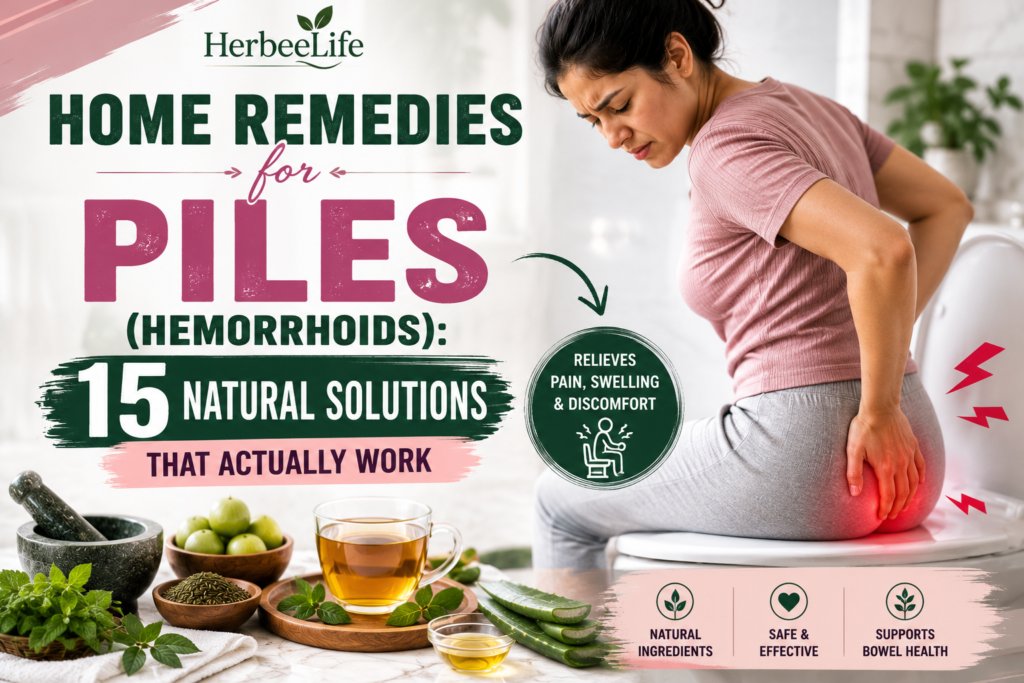

Home Remedies for Piles (Hemorrhoids): 15 Natural Solutions That Actually Work
Piles — known as bavasir, bawaseer, or mulavyadi in different parts of India — are one of the most common yet least talked-about health problems. The itching, burning, and sharp pain during bowel movements can feel impossible to bring up, even with a doctor. The good news is that for most people, mild to moderate piles respond remarkably well to natural, home-based care.
If you're reading this, chances are you've already experienced it: that sudden, sharp sting during a bowel movement, a lump near the anus that wasn't there before, or spots of bright red blood on the tissue that sent your heart racing. Piles, medically known as hemorrhoids, are swollen and inflamed blood vessels in the lowest part of the rectum and anus. They're extraordinarily common — studies suggest that roughly half of all adults will experience piles at some point by age 50 — yet very few people talk about them openly, which means most sufferers quietly Google their symptoms at 2 a.m. rather than asking anyone for help.
The good news is that piles are rarely dangerous, and in their early stages, they respond very well to simple lifestyle changes and natural remedies you likely already have in your kitchen. This comprehensive guide walks you through exactly what piles are, why they happen, 15 natural remedies to manage and shrink them at home, the foods that make them worse, special considerations for pregnancy and postpartum piles, and the warning signs that mean it's time to see a doctor rather than wait it out.
⚡ Quick Answer
- Fastest relief for pain and itching: A warm sitz bath for 15 minutes, 2–3 times a day
- Best daily habit to shrink piles over time: Isabgol (psyllium husk) plus 3–4 litres of water daily to soften stool
- Best topical remedy: Pure aloe vera gel or coconut oil applied gently to the area
- Best overnight Ayurvedic remedy: Triphala churna in warm water before bed
- Avoid: Straining, sitting for long periods, spicy/fried food, and delaying the urge to pass stool
- See a doctor if: Bleeding is heavy, a lump doesn't reduce after a few days, or pain is severe
📋 Table of Contents
- What Are Piles (Hemorrhoids)?
- What Causes Piles?
- Grades and Types of Piles
- Common Myths About Piles
- 15 Natural Home Remedies for Piles
- A Sample Daily Routine
- Piles During Pregnancy and After Delivery
- Foods That Worsen Piles (and Better Swaps)
- Lifestyle and Prevention Habits
- When to See a Doctor
- Frequently Asked Questions
What Are Piles (Hemorrhoids)?
Piles are swollen, inflamed veins and tissue cushions located in and around the anus and lower rectum. Everyone actually has these vascular cushions naturally — they help with continence by forming a soft seal. Piles develop when these cushions become engorged, stretched, or displaced, usually from repeated pressure, straining, or prolonged sitting. Depending on where they form, they are classified as internal (inside the rectum, usually painless but prone to bleeding) or external (under the skin around the anus, often painful, itchy, and sometimes visible as a lump).
In Indian households, piles go by many names depending on the region and language — bavasir and bawaseer in Hindi/Urdu, mulavyadi in Sanskrit-rooted Ayurvedic texts, and moolakkuru in Tamil. Regardless of what you call it, the underlying condition and the remedies that help are largely the same.
The symptoms typically include: a burning or itching sensation around the anus, pain or discomfort especially during and after passing stool, bright red blood on toilet paper or in the toilet bowl, a soft lump or swelling near the anal opening, and a feeling of incomplete evacuation after a bowel movement. Piles can range from a mild, occasional irritation to a persistent, painful condition that interferes with daily life — but the vast majority of cases, especially in the earlier stages, can be managed effectively without surgery.
The Ayurvedic perspective: In classical Ayurvedic texts, piles are called Arsha and are primarily linked to an imbalance of all three doshas, though Vata (dryness and irregularity) and Pitta (heat and inflammation) tend to dominate the picture. A weak digestive fire (Agni) leads to poor digestion and chronic constipation, which in turn causes the straining that damages the rectal veins over time. This is exactly why Ayurvedic remedies for piles focus so heavily on restoring healthy digestion and softening stool, rather than only treating the swelling itself — the two approaches are designed to work together rather than as separate problems.
What Causes Piles?
Piles develop when there's sustained, repeated pressure on the veins in the rectal and anal area. The most common contributing factors include:
Chronic constipation and straining: This is, by far, the single biggest cause. When stool is hard and difficult to pass, straining puts direct pressure on the anal veins, causing them to swell over time. If constipation is a recurring issue for you, it's worth addressing at the root — our detailed guide on natural remedies for constipation covers exactly how to fix this.
Prolonged sitting, especially on the toilet: Sitting for long periods, whether at a desk job or scrolling on the phone while on the toilet, increases pressure on the rectal veins and is one of the most underestimated causes of piles in modern, sedentary lifestyles.
Low-fibre, low-water diets: A diet low in fibre and fluids leads to harder stools, which means more straining, which means more pressure on those delicate veins. This is why almost every remedy for piles overlaps heavily with remedies for constipation.
Pregnancy: The growing uterus puts increased pressure on the pelvic veins, and hormonal changes relax vein walls, making pregnant women particularly prone to piles, especially in the third trimester and during labour.
Obesity and heavy lifting: Excess body weight and repeated heavy lifting (including at the gym) both increase abdominal pressure, which transmits down to the rectal veins over time.
Ageing: As we age, the tissues supporting the veins in the rectum and anus naturally weaken, which is why piles become more common after the age of 40–50.
Genetics: A family history of piles can make some people more prone to developing them, likely due to inherited vein wall strength or structural predisposition.
Grades and Types of Piles
Doctors typically classify internal piles into four grades based on severity, which helps determine whether home remedies alone are appropriate or whether medical treatment is needed:
Grade I
Small internal swellings, not visible outside, may cause mild bleeding. Responds very well to home remedies and diet changes.
Grade II
Larger swellings that may protrude during a bowel movement but retract on their own afterward. Home remedies remain highly effective here.
Grade III
Protrude during straining and need to be pushed back in manually. Home remedies can help manage symptoms, but medical evaluation is recommended.
Grade IV
Permanently protruded and cannot be pushed back in. This stage usually requires medical or surgical treatment.
If you're unsure which grade applies to your situation, or if a piles has progressed to the point where it no longer reduces on its own, our detailed guide on piles causes, grades, and when laser treatment is the right choice is worth reading alongside this one.
Common Myths About Piles
Because piles are so rarely discussed openly, a surprising number of myths surround them — and some of these myths actually delay proper care.
Myth: Piles always need surgery. In reality, the majority of Grade I and II piles never require surgical treatment at all. Surgery is generally reserved for advanced Grade III–IV cases or when other treatments have failed, not as a default first step.
Myth: Spicy food directly causes piles. Spicy food doesn't create piles on its own, but it can irritate an already inflamed area and worsen the burning sensation during a flare-up, which is why it's worth avoiding while symptoms are active.
Myth: Piles are a sign of a serious disease. While rectal bleeding should always be checked by a doctor to rule out other causes, piles themselves are a common, usually benign, mechanical condition related to pressure and straining — not typically a sign of a more serious underlying illness.
Myth: Only older people get piles. While piles do become more common with age, they're increasingly seen in younger adults too, largely driven by desk jobs, low-fibre diets, and long hours of sitting — a very modern lifestyle problem, not just an ageing one.
Myth: Once you have piles, you'll always have them. With consistent dietary and lifestyle changes, many people experience long stretches with no symptoms at all, or resolve mild piles completely. Recurrence is common only when the underlying causes go unaddressed.
15 Natural Home Remedies for Piles
The remedies below work through three main mechanisms: softening stool so there's less straining, soothing inflammation and pain directly, and improving overall blood flow and vein tone in the rectal area. For best results, most people benefit from combining 3–4 of these remedies together rather than relying on just one — for example, a sitz bath for immediate comfort, isabgol for long-term stool softening, and aloe vera or coconut oil for daily topical soothing.
| Remedy | Best For | How Fast It Works |
|---|---|---|
| Warm sitz bath | Pain, itching, swelling | Minutes |
| Isabgol (psyllium husk) | Straining, hard stool, bleeding | Days to weeks |
| Aloe vera / coconut oil | Itching, burning, dryness | Minutes to hours |
| Ice pack | Sudden swelling, sharp pain | Minutes |
| Triphala churna | Chronic constipation-driven piles | 1–2 weeks |
| Witch hazel | Minor bleeding, external irritation | Days |
🛁 Warm Sitz Bath
A sitz bath — sitting in a shallow basin of warm water that covers just the hips and buttocks — is one of the most universally recommended remedies for piles. The warmth increases blood flow to the area, relaxes the anal sphincter muscle, and provides real, noticeable relief from pain, itching, and swelling within minutes.
🛒 Recommended: Foldable Sitz Bath Tub
A dedicated sitz bath basin that fits over your toilet seat makes this remedy far more convenient and hygienic to do consistently, 2–3 times a day, without needing a full bathtub.
Check Price on Amazon →🌾 Isabgol (Psyllium Husk)
Isabgol is arguably the single most important daily remedy for piles because it directly addresses the root cause: hard stool and straining. As a soluble fibre, it absorbs water in the gut and forms a soft, bulky stool that passes with minimal pressure on the inflamed veins.
🛒 Recommended: Organic Psyllium Husk (Isabgol)
Choose a pure, unbleached psyllium husk without added sugar or flavouring — it dissolves more cleanly and is gentler on an already-irritated gut.
Check Price on Amazon →🌿 Aloe Vera Gel (Topical)
Fresh aloe vera gel has natural anti-inflammatory and cooling properties that can soothe the burning and itching sensation of piles almost immediately upon application, while also supporting the skin's natural healing process.
🧊 Ice Pack / Cold Compress
Cold therapy constricts blood vessels, which reduces swelling and numbs the area enough to provide quick, temporary relief from pain, especially for external piles that are actively inflamed.
🌰 Witch Hazel
Witch hazel is a natural astringent that reduces inflammation, itching, and minor bleeding when applied topically, making it a popular over-the-counter and home remedy combination for external piles specifically.
🥥 Coconut Oil
Coconut oil has natural anti-inflammatory and mild antimicrobial properties, and its thick, emollient texture also acts as a lubricant that can ease the passage of stool and reduce friction-related irritation.
🌿 Neem Paste or Neem Water Wash
Neem is well known in Ayurveda for its antimicrobial and anti-inflammatory properties, which help prevent infection in irritated or slightly broken skin around inflamed piles, while also calming redness and itching.
🟡 Turmeric Paste
Turmeric's active compound, curcumin, has well-documented anti-inflammatory and wound-healing properties, which can help reduce swelling and support tissue repair when applied directly to irritated skin.
🌿 Triphala Churna at Bedtime
Triphala is a classic Ayurvedic formulation that gently tones the digestive tract and improves bowel regularity over time, making it one of the most trusted overnight remedies for people whose piles are driven by chronic constipation.
🥛 Buttermilk (Chaas) and Light, Cooling Foods
Buttermilk is naturally probiotic, cooling, and easy to digest, making it an excellent daily addition for anyone dealing with piles, since it supports gut health without adding to digestive strain or heat-related irritation.
💧 Increased Water Intake
Adequate hydration is one of the simplest yet most overlooked remedies. Without enough water, even a high-fibre diet can worsen constipation, since fibre needs fluid to do its job of softening stool properly.
🍇 Fibre-Rich Fruits: Papaya, Figs, and Soaked Raisins
A daily dose of fibre-rich fruit softens stool naturally and reduces the need to strain, which is the single biggest driver of piles. Papaya, soaked figs, and soaked raisins are particularly gentle and effective options.
🚶 Gentle Daily Walking
Movement stimulates healthy bowel function and improves overall circulation, both of which directly counter the two biggest contributors to piles: constipation and prolonged sitting.
🧘 Avoiding Straining and Practising Proper Toilet Posture
How you sit matters more than most people realise. A squatting posture (achieved easily with a small footstool under a Western-style toilet) straightens the anorectal angle, allowing stool to pass with far less effort and pressure.
🌸 Ghee with Warm Milk at Night
A teaspoon of ghee in warm milk before bed is a gentle Ayurvedic remedy that lubricates the intestines, easing the passage of stool and indirectly reducing the anal irritation and straining associated with piles.
A Sample Daily Routine to Manage Piles Naturally
With 15 remedies on one page, it's easy to feel overwhelmed about where to actually start. Here's a simple routine that brings the most effective remedies together into one realistic day, rather than trying everything at once.
Morning: Start with a glass of warm water on an empty stomach, followed by a bowl of soaked figs or raisins with breakfast. Practise proper toilet posture (feet elevated on a small stool) and avoid straining. If it's a flare-up day, follow with a 15-minute warm sitz bath.
Afternoon: Have a glass of buttermilk with lunch, favour light, cooling, home-cooked food over fried or spicy options, and take a short 10-minute walk after eating rather than sitting immediately. Apply aloe vera gel or coconut oil to the area if there's irritation.
Evening: Fit in your main daily walk of 20–30 minutes, and if you sit for long stretches at work, make sure you've stood up and moved every hour throughout the day.
Night: Drink isabgol mixed in warm water or milk, or Triphala churna, about 30–45 minutes before bed. Do a final sitz bath if needed, clean the area gently, and pat dry rather than rubbing before sleeping.
Repeating this routine consistently for 2–3 weeks is usually enough to see a meaningful difference in swelling, pain, and bleeding for mild to moderate piles — the key is consistency rather than intensity, since piles respond far better to steady daily habits than to occasional, aggressive treatment.
🤰 Piles During Pregnancy and After Delivery
Piles are extremely common during pregnancy, particularly in the second and third trimesters, due to the combined effect of increased pelvic pressure from the growing uterus, hormonal changes that relax vein walls, and pregnancy-related constipation. They're also very common after delivery, especially following the pushing involved in vaginal birth.
For pregnant and postpartum women, the safest starting approach is almost always non-invasive: warm sitz baths, gentle fibre-rich foods, plenty of water, and light daily movement, all of which are safe for most pregnancies. Stronger remedies like castor oil or Triphala in higher doses should only be used after checking with a doctor, since some natural remedies aren't recommended during pregnancy. If you're navigating other pregnancy-related digestive changes as well, our trimester-by-trimester pregnancy guide covers what to expect and how to manage it safely.
Foods That Worsen Piles (and Better Swaps)
Just like with constipation, diet plays an enormous role in how often piles flare up and how quickly they heal. Here's a quick reference table of common culprits and simple swaps.
| Common Trigger | Why It's a Problem | Better Swap |
|---|---|---|
| Refined flour (maida) and bakery items | Very low fibre, worsens constipation and straining | Whole wheat, oats, millets (jowar/bajra) |
| Deep-fried and spicy food | Can irritate the digestive tract and worsen inflammation | Steamed, lightly sautéed, mildly spiced meals |
| Excess tea, coffee, and alcohol | Can dehydrate the body and harden stool | Herbal tea, buttermilk, coconut water |
| Red meat and heavy, rich food | Slow to digest, low in fibre, can worsen constipation | Lighter proteins like dal, paneer, and fish in moderation |
| Low water intake | Hardens stool, increasing straining and pressure on veins | 3–4 litres of water daily, spread through the day |
Lifestyle and Prevention Habits
Beyond specific remedies, a handful of daily habits make a significant long-term difference in preventing piles from recurring:
Don't delay the urge: Holding in a bowel movement allows the stool to dry out and harden further, making the next attempt more difficult and more likely to cause straining.
Limit toilet time: Reading or scrolling on your phone while sitting on the toilet keeps unnecessary pressure on the anal area for far longer than needed. Try to keep bathroom visits under 5 minutes.
Maintain a healthy weight: Excess weight, particularly around the abdomen, increases pressure on the pelvic and rectal veins over time.
Stay consistent with fibre and water: This is the single most protective long-term habit against both constipation and piles — treat it as a daily non-negotiable rather than something you do only during a flare-up.
Keep the area clean and dry: Gently clean the area with water after every bowel movement rather than relying only on dry toilet paper, and pat dry rather than rubbing, to reduce irritation.
Choose the right seating: If you sit for long hours at work, a soft cushion with a cut-out centre can reduce direct pressure on the anal area, and standing up to stretch every hour makes a meaningful difference over a full workday.
Wear breathable clothing: Tight, synthetic underwear can trap moisture and heat around the anal area, which can worsen irritation. Loose, breathable cotton clothing helps keep the area dry and reduces friction-related discomfort.
If you'd like a broader digestive reset alongside these habits, our guides on how to improve digestion naturally and boosting digestion with home remedies pair well with everything covered here.
🚩 When to See a Doctor
Mild to moderate piles (Grade I and II) usually respond very well to the remedies above within 1–2 weeks. However, please consult a doctor if you experience: heavy or persistent bleeding, a lump that doesn't reduce in size or becomes increasingly painful, severe pain that doesn't improve with sitz baths and rest, signs of infection such as fever or pus, or if symptoms persist beyond 2–3 weeks despite consistent home care. Sudden, significant blood loss or very dark, tarry stool should be treated as urgent and evaluated immediately, as these can occasionally indicate a different underlying condition rather than piles alone. Our detailed guide on when laser treatment for piles is the right choice and our guide to anal fissures and fistulas explain what the next steps typically look like if home care isn't enough.
Frequently Asked Questions
What is the fastest home remedy for piles pain relief?
A warm sitz bath provides the fastest noticeable relief for pain, itching, and swelling, often within 15–20 minutes. Combining it with a cold compress in between sessions can further reduce swelling for external piles.
Can piles be cured naturally without surgery?
Grade I and II piles very often improve significantly, and sometimes resolve entirely, with consistent natural remedies, fibre, hydration, and lifestyle changes. Grade III and IV piles may need medical intervention alongside home care, since they no longer retract on their own.
What home remedy works best for bleeding piles?
Softening the stool with isabgol and plenty of water is the most important step, since bleeding is usually triggered by straining against hard stool. Witch hazel applied topically can also help reduce minor bleeding and irritation. Heavy or persistent bleeding should always be checked by a doctor.
Is it safe to use home remedies for piles during pregnancy?
Most gentle remedies — sitz baths, fibre-rich foods, hydration, and light movement — are generally considered safe during pregnancy. However, pregnant women should check with their doctor before using stronger remedies like Triphala in high doses or castor oil.
How long does it take for natural remedies to shrink piles?
Many people notice reduced pain and itching within a few days of starting sitz baths and topical remedies, while shrinking of the swelling itself through diet and fibre changes typically takes 1–3 weeks of consistent effort.
What foods should I completely avoid if I have piles?
Refined flour products, deep-fried and very spicy food, excess tea/coffee/alcohol, and low water intake are the biggest culprits to avoid. Focus instead on fibre-rich fruits, whole grains, and plenty of fluids.
Can piles come back after they heal?
Yes — if the underlying causes (constipation, prolonged sitting, low fibre and water intake) aren't addressed long-term, piles can recur. Maintaining the prevention habits covered above is key to keeping them from coming back.
What is the difference between internal and external piles?
Internal piles form inside the rectum and are usually painless, though they can bleed during bowel movements. External piles develop under the skin around the anus and tend to be more painful, itchy, and sometimes visible as a soft lump, especially when irritated or thrombosed.
Can exercise or yoga help with piles?
Gentle daily walking and light movement genuinely help by improving circulation and reducing constipation. However, heavy weightlifting or intense straining exercises can worsen piles by increasing abdominal pressure, so it's best to avoid those during a flare-up.
📖 Related Reads on HerbeeLife
🌿 Loved These Remedies?
Follow HerbeeLife for daily Ayurvedic tips, natural remedies, and wellness inspiration you won't find anywhere else.